HISTORY OF THE TEMPLE
In the mid-17th century, around the year 1664, a resident of the city of Almendralejo named Fernando Nieto Becerra, “moved by charity and devotion,” together with his wife Juana Alvarado Mendoza and her sister Leonor, committed themselves to building the convent and church of Saint Anthony of Padua at their own expense and to ensuring that the income derived from a Pious Work founded upon their property could sustain the community of Discalced Franciscans established in the convent.
The founders died a few years later. They were buried in the Parish Church of the town while awaiting the construction of this temple. By the end of 1697, the church had been completed, and its façade bears the inscription of the year 1694. On November 25, 1717, their bodies were transferred to this burial site, which is located beside the steps of the High Altar. The Alcantarian Franciscan Fathers, from the province of Saint Gabriel “infra Tagum,” settled in the newly built convent of Saint Anthony of Padua, having come from the convent of Our Lady of Light in the Portuguese town of Moncarche, near Alconchel, a convent and town destroyed by the Portuguese during their War of Independence.
On September 14, 1698, the Blessed Sacrament was solemnly placed in the church (Feast of the Exaltation of the Cross 300 years ago: it is significant that we are now remembering it before Christ nailed to the Cross, dying, the Most Holy Christ of the Good Death). However, the convent was not officially declared completed until 1785. Fifty years later, on September 28, 1835, the convent was permanently closed due to the Confiscation Laws; the friars had been expelled a few days earlier.
The convent building later served various purposes under different owners (alcohol and flour factories, cinema, “Our Lady of Piety” school, etc.); most of it, after having remained in ruins for a long time, was fortunately restored as the House of Culture and the Official Conservatory of Music. The church was almost abandoned until an exemplary priest, Jerónimo Carballar, emerged and during the first quarter of our century kept the temple standing with the necessary repairs, built the hermitage house (year 1901, on its façade), founded religious associations (Third Order, Bread for the Poor), and tirelessly spread devotion to Saint Anthony of Padua.
After his death, in 1926, the various circumstances of our history once again led to the abandonment of the church until, in the 1950s, another exemplary person appeared: Francisca Calero García, President of the Brotherhood of Saint Anthony from its founding in 1954 until her death in 1998. The Franciscan community lived here until 1835, when they were forced to abandon the convent because of the Mendizábal Confiscation.
On April 14, 1993, the Regional Ministry of Environment, Urban Planning and Tourism of the Regional Government of Extremadura declared the monument a Site of Cultural Interest with a defined Protection Area. On February 21, 2022, the Holy See, through the Apostolic Penitentiary, granted the gift of the Plenary Indulgence to the faithful who visit this temple, thanks to the spiritual bond of affinity established with the Papal Basilica of Saint Mary Major in Rome, which was decreed on February 22, 2022, making it a Perpetual Jubilee Temple. One year later, on May 17, Archbishop Celso Morga Iruzubieta of Mérida-Badajoz declared this Conventual Church of Saint Anthony of Padua a Diocesan Shrine. The Shrine belongs to the jurisdiction of the Parish of Our Lady of the Purification.
ART
The temple has a Latin cross floor plan with a transept and a square chancel. It has a nave covered by a flattened barrel vault with transverse arches, while the transept is topped by a hemispherical dome resting on pendentives with a lantern at its center. Its vaults are quite elevated; the church measures 30 meters long by 7.30 meters wide, while the transept measures 16.30 meters. Behind the main altarpiece there is a dressing chamber, which must once have been magnificent judging by the remains of its mural paintings. The floor still preserves its original tiles.
The floor of the temple, from the main entrance to the transept, is covered with humble Franciscan tombs: eighty-one graves with granite slabs, bearing no inscription other than a number, containing the remains of Alcantarian religious who lived serving the Lord in this magnificent foundation.
It contains three highly valuable 17th-century altarpieces. The High Altar altarpiece, dating from the time of the foundation and in Churrigueresque style, features not only the image of Saint Anthony of Padua, to whom the temple is dedicated, but also the images of Saint Francis of Assisi and Saint Peter of Alcántara on either side. In the upper section are sculptures of the Immaculate Conception—in the center—as well as Saint Ferdinand and Saint John the Evangelist, saints whose names correspond to those of the founders. All the sculptures are of remarkable craftsmanship.
WORSHIP
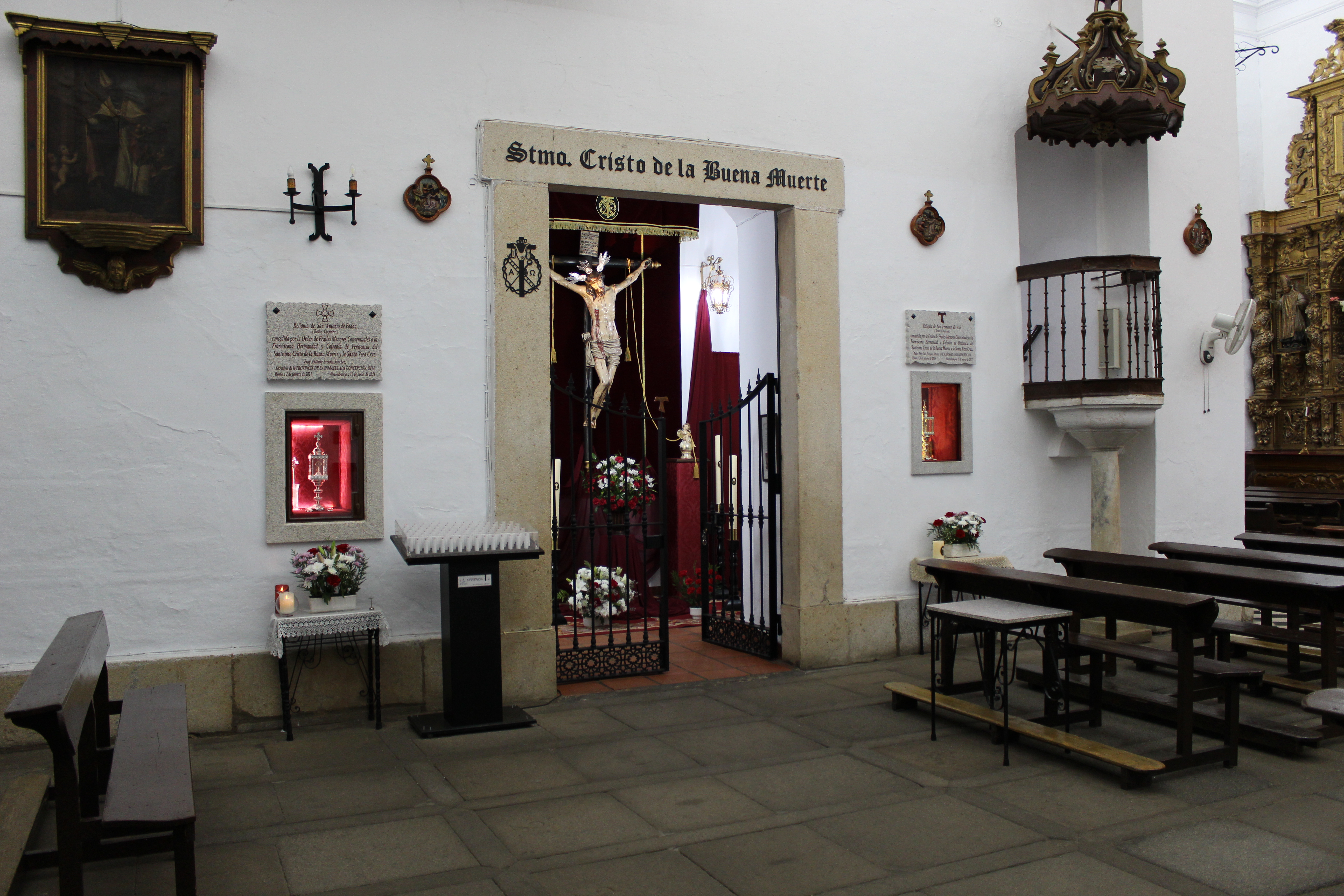
The temple remains open every day of the year, morning and afternoon. On Sundays, Holy Mass is celebrated at 10:00 a.m. Likewise, the Thirteen Tuesdays of Saint Anthony of Padua, the Novena in his Honor, and the Procession on his feast day are celebrated. Parishioners continuously pass through the Shrine throughout the day. This temple is the Canonical Seat of the Brotherhood of Saint Anthony and the Franciscan Brotherhood and Penitential Cofradía of the Most Holy Christ of the Good Death and the Holy True Cross. Every Holy Thursday, from noon to 3 p.m., the Brotherhood of the Good Death performs the act of “The Prayer of the Three Creeds.” In addition, during the early hours from Holy Thursday to Good Friday, it carries out its Penitential Station (Way of the Cross) with the Venerated image of the Most Holy Christ of the Good Death.
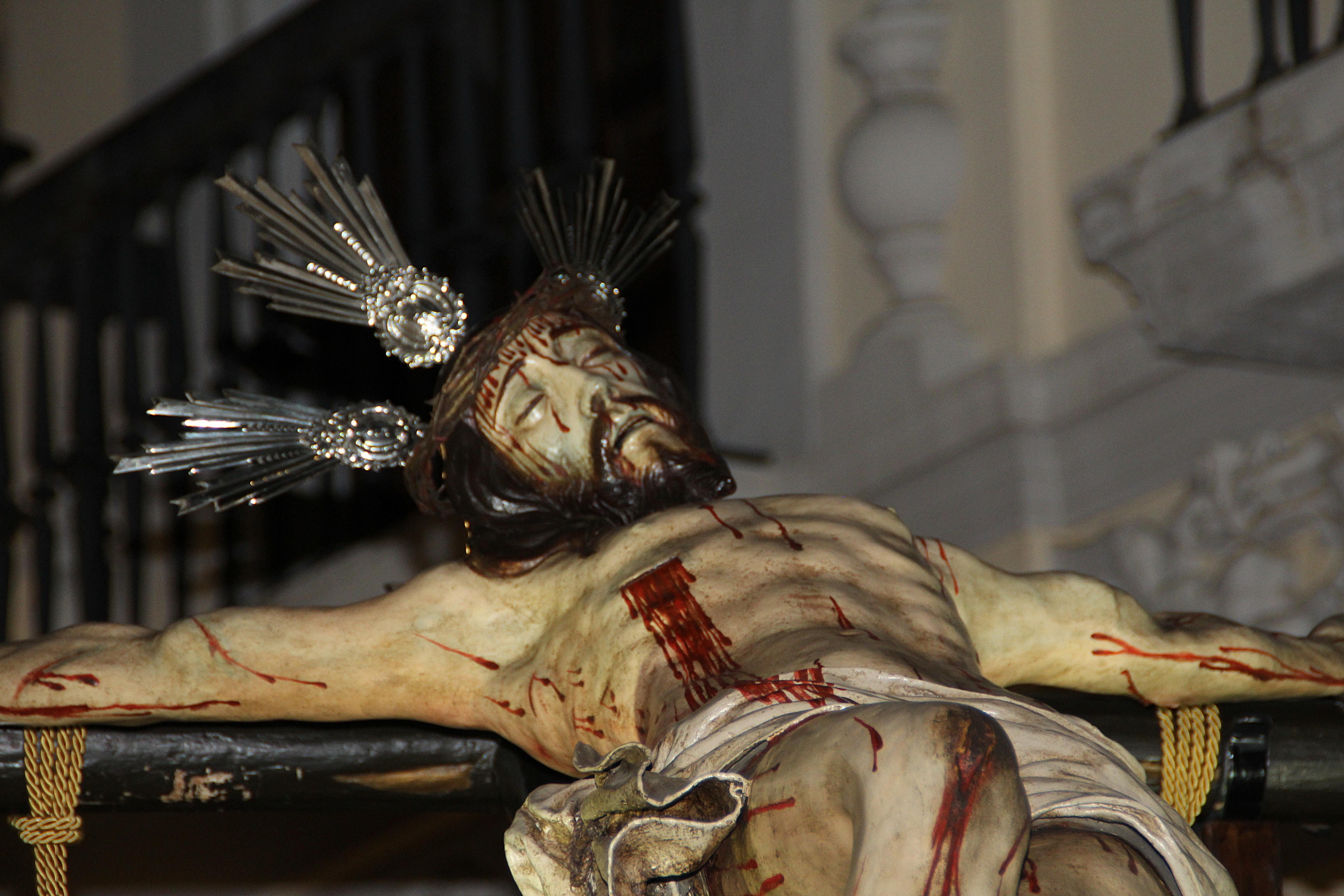
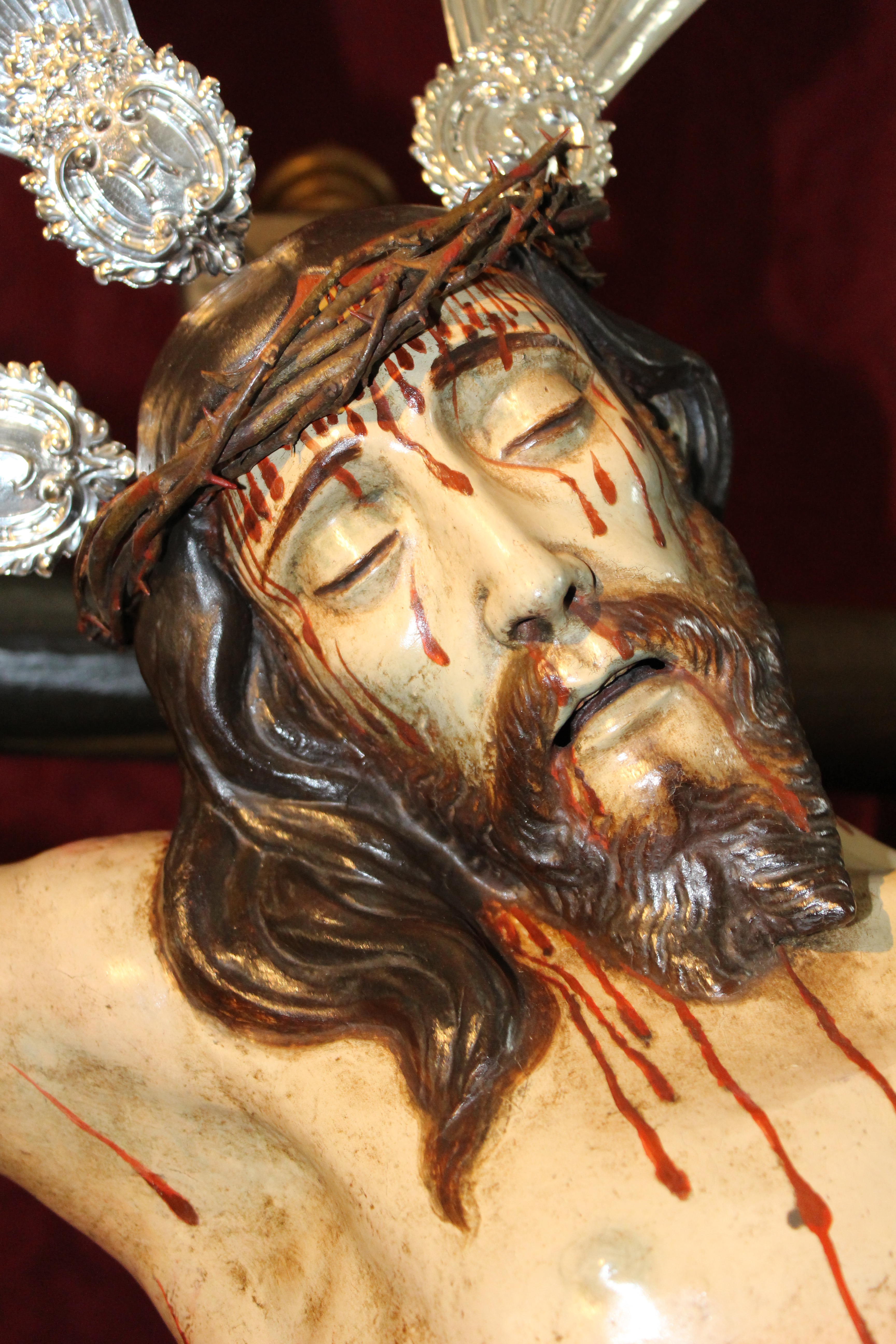
According to some restorers, the image of the Most Holy Christ of the Good Death dates back to the 18th century. The author is unknown, but according to experts, after studying its details, it could be attributed to the “Artistic Circle of Jerónimo de Valencia.” It is a dead Christ, with his head inclined to the right, nailed to a cross and bearing various wounds; it is of great artistic value. It conveys great peace and serenity and is deeply venerated by all parishioners. The image consists of five pieces and a loincloth. The material used is mainly papier-mâché and animal glue. It displays a great variety of burnished oil colors. Its dimensions are 1.50 meters high by 1.10 meters from arm to arm. The sculpture has undergone several restorations, the most recent in 1990, carried out by Luis Peña Maldonado and Fernanda Zapata Castillo, residents of the town of Llerena in the province of Badajoz. It appears that the image had been restored previously, although there is no documentation regarding this. The reason for the latest restoration was the severe deterioration caused by the passage of time, scorching from candle heat, cracking, repainting, detachments, etc. The restoration lasted two months.
The Christ figure is secured upon a carved circular-section cross. The tips are gilded with 22-carat gold, and at the upper part of the cross there is a plaque bearing the inscription “Jesus of Nazareth, King of the Jews” in different languages (Hebrew, Greek, and Latin). Resting upon Christ’s head are a crown of thorns and three silver rays with the inscription “J H S,” replacing the previous rays, decorated with an eight-pointed star design, which disappeared in 1992. Finally, as a curiosity, it is possible to observe Christ’s own face on his stomach.
HOLY RELICS
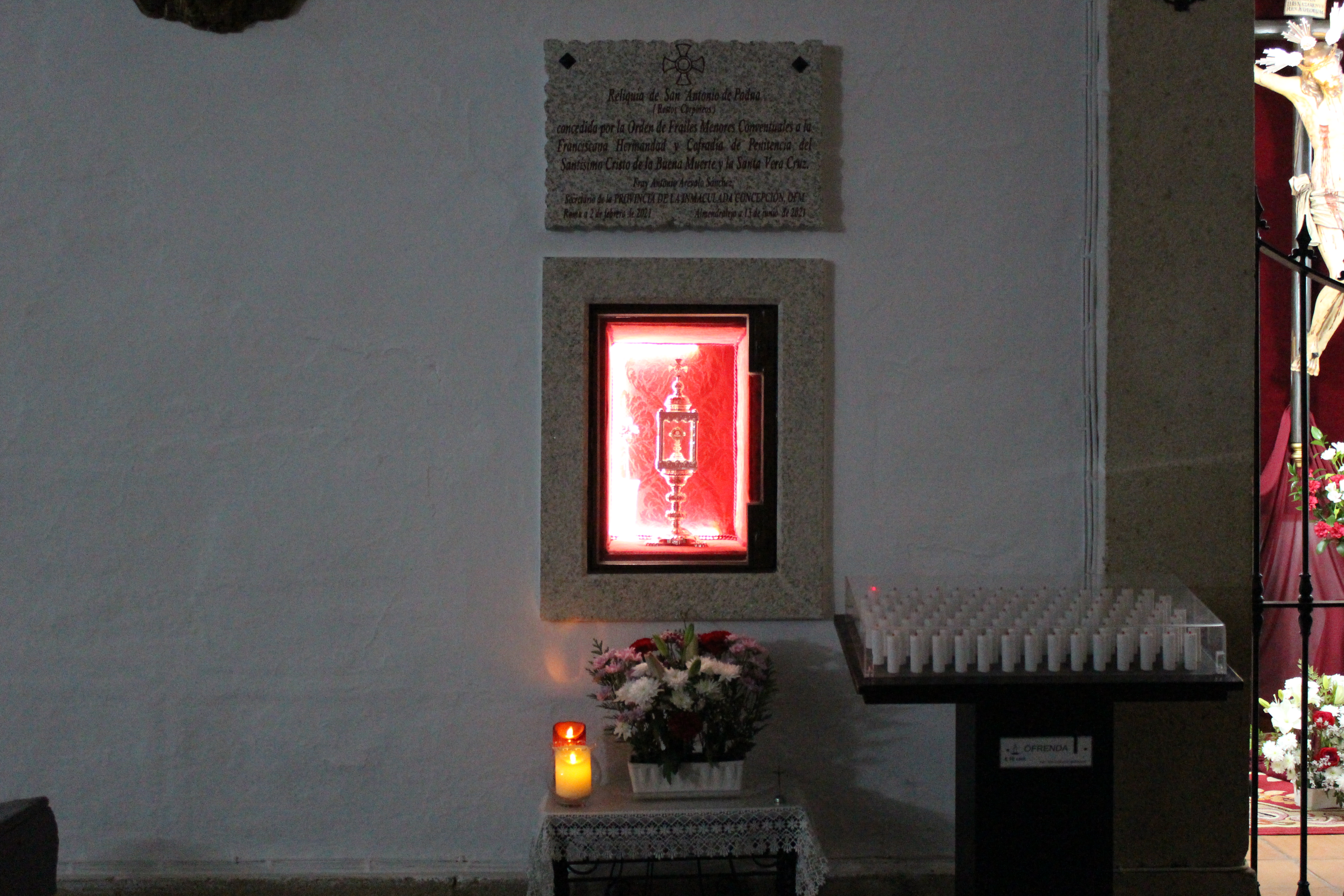
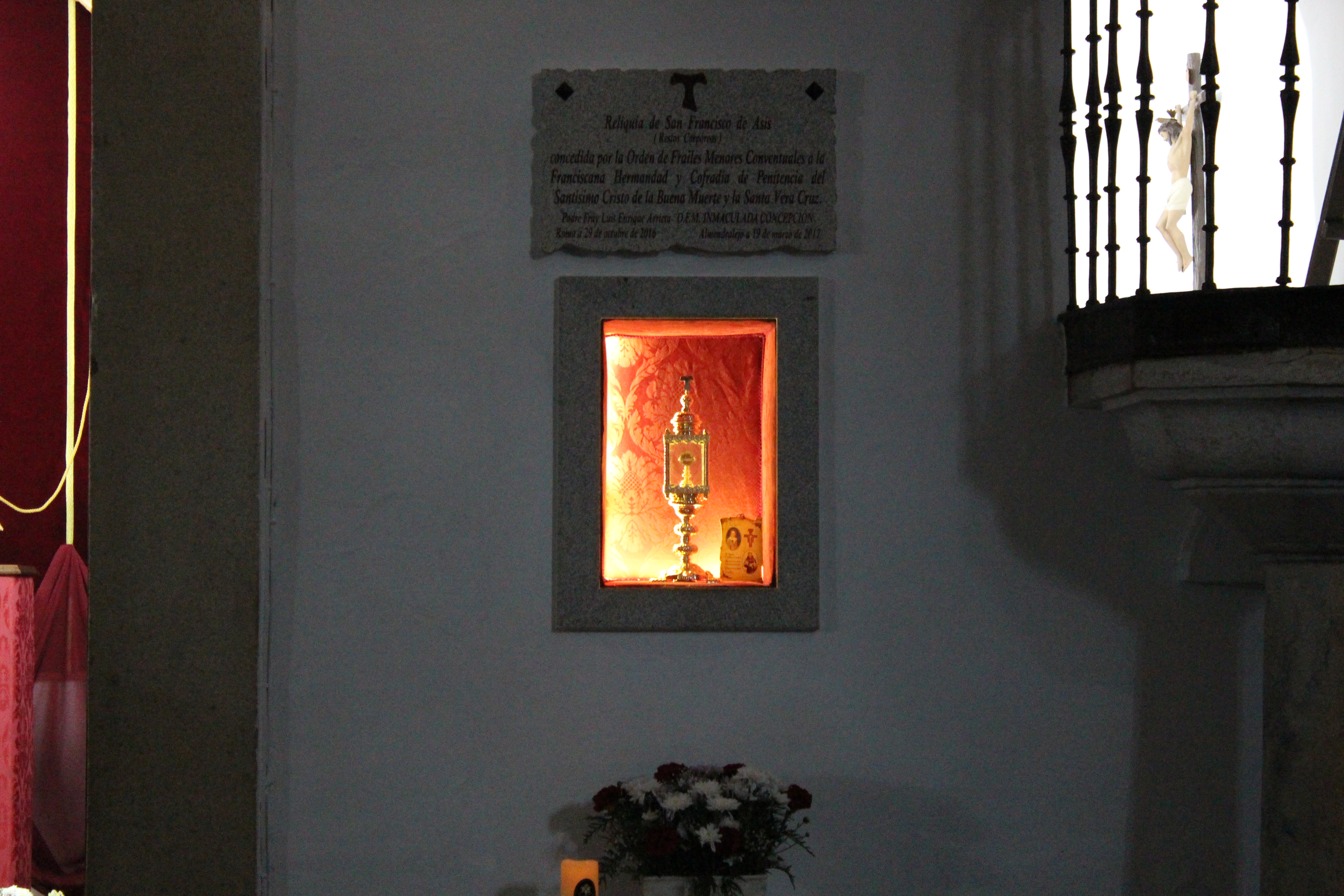
This Shrine possesses as a spiritual treasure a Holy Relic of Saint Francis of Assisi and another of Saint Anthony of Padua, belonging to the Franciscan Brotherhood of the Good Death and the Holy True Cross. Both Relics are located beside the Chapel of the Most Holy Christ of the Good Death. The Holy Relic of Saint Francis of Assisi, 1st class, (CINERIBUS CORPORIS), was granted on October 29, 2016, by the Order of Friars Minor Conventual of the city of Rome (Italy).
On March 19, 2017, Fr. Luis Enrique Arieta, belonging to the Order of Friars Minor, OFM, of the Province of the Immaculate Conception of Ávila, delivered this Holy Relic. The Holy Relic of Saint Anthony of Padua, 1st class, (EX OSSIBUS), was granted on February 2, 2021, by the Order of Friars Minor Conventual of the city of Rome (Italy). On June 13, 2021, Fr. Antonio Arévalo Sánchez, Secretary of the Province of the Immaculate Conception, OFM, Madrid, delivered this Holy Relic.
PERPETUAL JUBILEE TEMPLE PETITION TO POPE FRANCIS BY MSGR. CELSO MORGA, OUR ARCHBISHOP, AND DECREE OF THE APOSTOLIC PENITENTIARY
Papal Basilica of Saint Mary Major in Rome. Spiritual bond with the Conventual Church of Saint Anthony of Padua in Almendralejo, Diocese of Mérida-Badajoz (Emeritensis Augustanus-Pacensis), Spain.
MOST BLESSED FATHER: Celso Morga Iruzubieta, Metropolitan Archbishop of Mérida-Badajoz, with the favorable opinion of the Most Eminent Cardinal Archpriest of the Papal Basilica of Saint Mary Major, humbly raises his supplications to Your Holiness so that You may deign to grant the gift of the Plenary Indulgence to the faithful who devoutly visit the said Conventual Church of Saint Anthony of Padua in Almendralejo.
The spiritual union, through prayers and good works, with the principal Marian Temple, in whose likeness the days enriched
with the Indulgence are granted, was born to strengthen filial hierarchical communion with Your Holiness, and at the same time the sense of Catholic unity, since such union is pleasing
to the faithful of the Church spread throughout the world.
THE APOSTOLIC PENITENTIARY, by virtue of the faculties specially granted by the Supreme Pontiff, gladly accepts the aforementioned petition and grants the Plenary Indulgence, provided that the customary conditions are duly fulfilled (Sacramental Confession, Eucharistic Communion, and prayer for the intentions of the Supreme Pontiff), to the faithful who, being truly repentant, devoutly attend some sacred function in the Conventual Church of Saint Anthony.
a.- On August 5, titular feast of the Basilica of Saint Mary Major.
b.- On June 13, titular feast of the conventual church of Saint Anthony of Padua.
c.- On all Solemnities of the Virgin: (January 1 -Saint Mary, Mother of God-; March 25 -Annunciation of the Lord-; August 15 -Assumption of the Virgin into Heaven-; December 8 -Immaculate Conception-).
d.- Once a year, on a day freely chosen by each faithful person.
e.- Whenever they participate in a devout collective pilgrimage.