DESCRIPTION
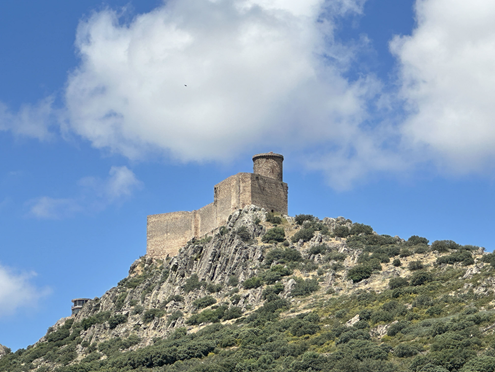
The castle of Puebla de Alcocer, also known as the castle of Alcocer or of the Sotomayor family, stands in a strategic enclave in the province of Badajoz, dominating the landscape of La Siberia in Extremadura.
Its origin and configuration are closely linked to the 15th century and to the political changes in Castile under Juan II. It was in 1445 that the monarch granted the town of Puebla de Alcocer to Gutierre de Sotomayor, master of the Order of Alcántara, who quickly promoted the construction of the fortress out of fear of Toledo, which had bought these lands of Alcocer from Fernando III in 1246.
Don Gutierre’s fears were not unfounded, since in August 1448 Luis González de León, a resident of Puebla de Alcocer, contacted Toledo so that certain officials might come furtively to seize the castle before its construction was completed.
But the protest against the construction of the new castle did not come only from Toledo, but also from the Order of Alcántara which, on the other side of the mountain range, accused the Sotomayor family of building it on lands belonging to the Priory of Magacela and Zalamea, requiring the mediation of Pope Nicholas V. He wrote an apostolic letter to the prior of the Monastery of Guadalupe, commissioning him to determine whether it was advisable to exchange the Castle of Puebla de Alcocer for other assets.
The keep and the other rooms were completed by Don Gutierre’s daughter-in-law, Elvira de Zúñiga, widow of Alonso de Sotomayor, in 1467. The most reliable data confirm that the construction of the castle was carried out entirely in the 15th century.
Gutierre de Sotomayor died on 12 October 1453. Despite having taken a vow of chastity, he left pensions to forty women and recognised fifteen children. His wish was to be buried in Guadalupe, but he was buried in the Church of Puebla de Alcocer until 1481, when his remains, together with those of his son Alonso de Sotomayor, were taken to the convent of San Francisco in Belalcázar.
HISTORY
The definitive configuration of the building is closely linked to the 15th century and to the political changes in Castile under Juan II. It was in 1445 that the monarch granted the town of Puebla de Alcocer to Gutierre de Sotomayor, master of the Order of Alcántara, who promoted the construction or extensive remodelling of the fortress as a symbol of his territorial power.
The choice of location was not accidental. The castle stands on a steep crag that acts as a natural defence, reinforcing its almost impregnable character. This commanding position not only allowed control of the surrounding territory, but also visual contact with other nearby fortresses, such as Herrera del Duque, forming part of a coherent defensive network in the region. Over time, ownership of the castle changed hands through marriage alliances and inheritance. At the end of the 15th century it came under the control of the Zúñiga family, specifically of Doña Elvira de Zúñiga. This transfer of power was reflected in the architecture of the building itself, where the heraldic coats of arms of both the Zúñiga and the Sotomayor families can still be seen today, a stone testimony to the different stages of lordly dominion.
As a whole, the history of the castle reflects the power dynamics of the Castilian nobility in the 15th century: the consolidation of lineages, the importance of the military orders and the use of defensive architecture as a political instrument and symbol of authority.
Some rooms of the castle were renovated during the Carlist Wars and it served as an ammunition store and as a prison. In the mid-1990s, the architect Santiago Esteban Hernán Martín directed a new restoration of the fortress.
With regard to its origins, some opinions claim that it stands on Arab ruins, but there is no document to attest to this. Other sources state that the southern part was built partly on land belonging to the Order of Alcántara, which protested against it. In fact, the intervention of the Pope was necessary, and he appointed the prior of the Monastery of Guadalupe as mediator.
HISTORICAL-ARTISTIC DESCRIPTION
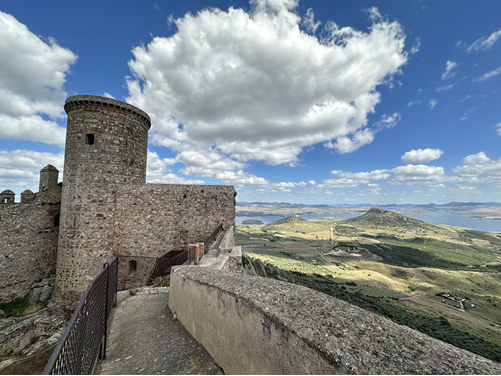
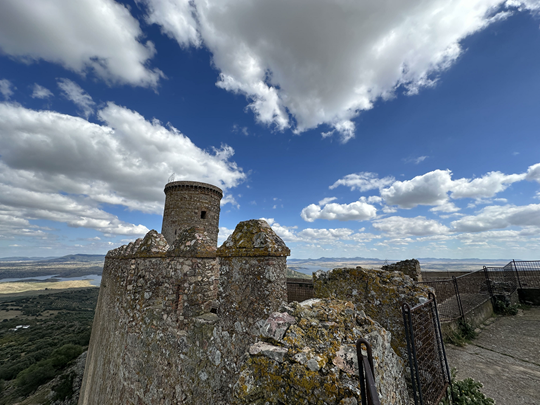
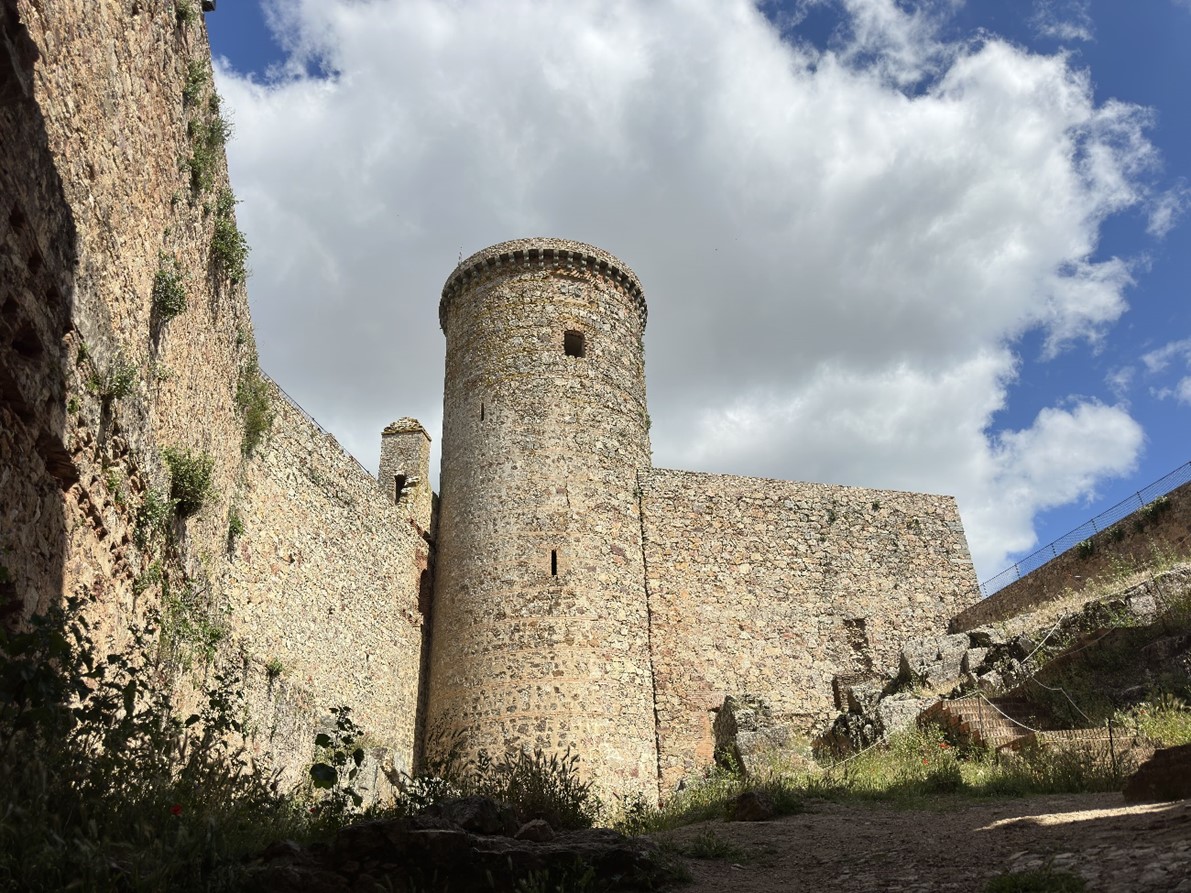
From an architectural point of view, the castle has an irregular floor plan, clearly adapted to the topography of the terrain. Its robust, compact walls reach thicknesses of between two and three metres and have no openings to the exterior, reinforcing their defensive character. The main entrance is carefully designed: it is protected by higher stretches of wall and by an attached cylindrical tower, creating a narrow space that was easy to defend.
In addition, the entrance system is arranged on two levels, with an outer pointed arch and an inner doorway connected by a vault that includes an upper opening from which potential invaders could be attacked.
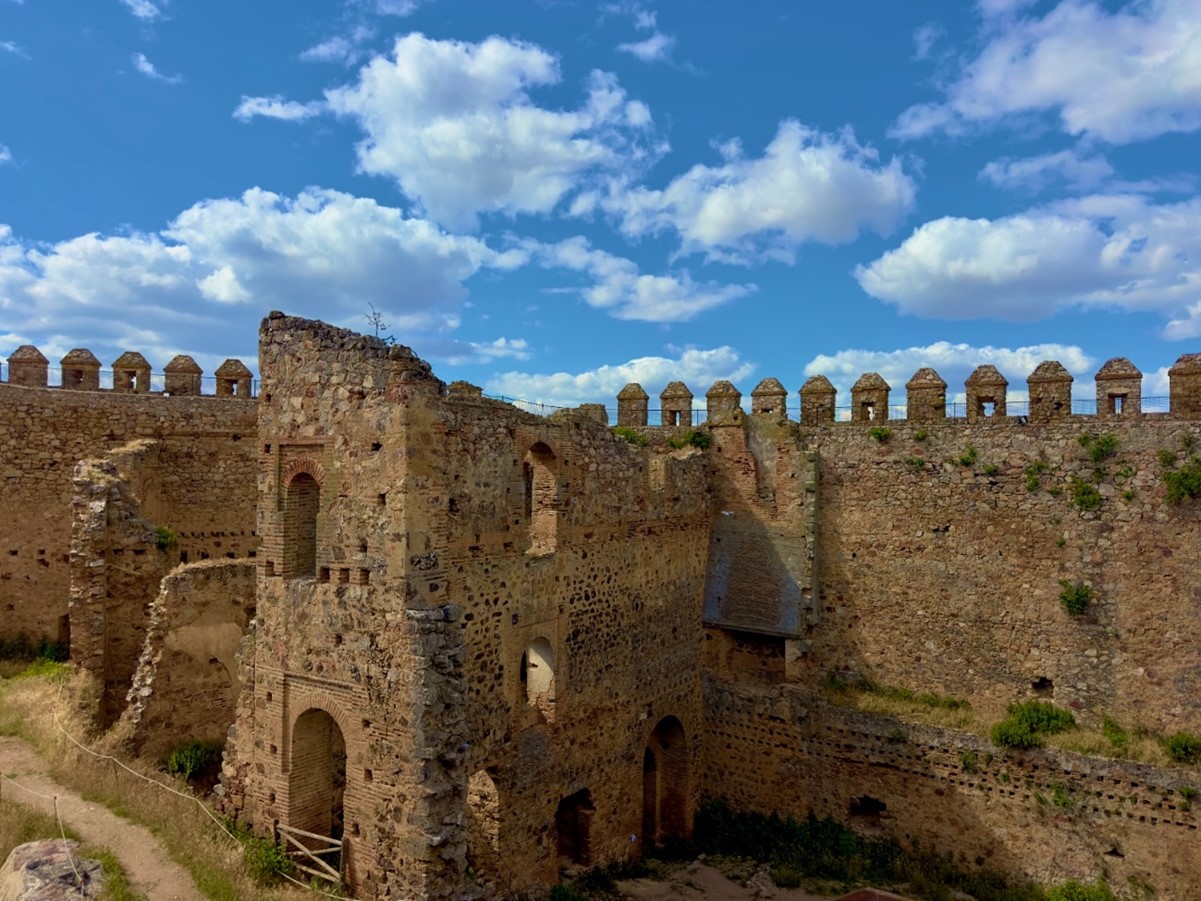
Beyond the entrance were the residential rooms, today very deteriorated but still legible thanks to construction remains such as putlog holes indicating the existence of several levels. These elements make it possible to mentally reconstruct a building of at least three storeys, with relatively complex living spaces for a fortress of its kind. Among the preserved remains, a fireplace stands out, its structure still partially standing.
The use of materials and construction techniques reveals the intervention of master builders of Mudéjar tradition. Elements such as brick-framed openings and decorative alfiz mouldings point to an aesthetic shared with other fortresses in the area, showing the survival of Islamic influences in the Christian architecture of the period.
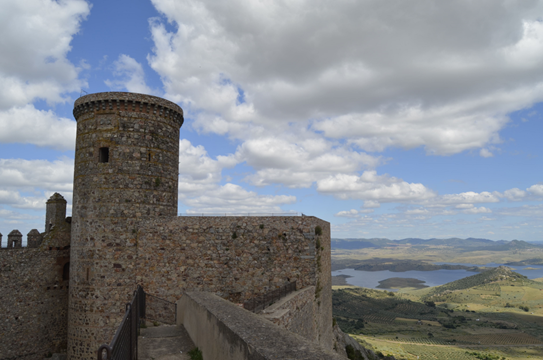
The Torre del Homenaje is the most outstanding element of the complex. Circular in plan and very tall, it is integrated into the wall but projects sufficiently to dominate the surrounding landscape visually. Its elevated access from the wall-walk and its internal system of stairways embedded in the wall reflect a highly sophisticated defensive concept. At the top, a projecting terrace supported by corbels completes the design. In addition, its masonry incorporates horizontal brick bands which not only fulfil a structural function, but also help to date some phases of construction to later moments in the 15th century, coinciding with the dominance of the house of Zúñiga.
RELEVANT FIGURES RELATED TO THE POI
The figure of Gutierre de Sotomayor belongs to the complex political and military framework of 15th-century Castile. Born into a family linked to the Order of Alcántara, he was the son of Gil García de Raudona and Catalina, sister of the influential master Juan de Sotomayor. His childhood probably took place in Valencia de Alcántara, under the protection of his uncle, whose position within the order proved decisive in shaping his career.
The early death of his mother marked a turning point for the family and favoured the full integration of his circle into the Alcántara militia, where Gutierre began a rapid rise: first as clavero, later as comendador mayor from 1426, also accumulating the encomienda of Portezuelo. His leap to the political front line took place in 1432, amid the crisis caused by the rebellion of the so-called “infantes de Aragón”.
His long mastership, which lasted for more than two decades, was marked by constant loyalty to the royalist cause. Gutierre de Sotomayor became one of the fundamental supports of royal power against the noble tensions that shook the kingdom. He took an active part in decisive episodes of the confrontation between the Crown and the high nobility, especially during the critical years of the 1440s. His actions were decisive in strategic enclaves such as Toledo, Trujillo and Mérida, and he played a prominent role in the campaign that culminated in the royalist victory at the battle of Olmedo in 1445, which brought about the definitive decline of the infantes de Aragón.
Nevertheless, he was not a brilliant military strategist. Indeed, his first warlike incursions on the Andalusian frontier resulted in significant human losses, revealing certain limitations in this field. By contrast, his political ability and his skill in consolidating patrimonial power proved far more effective. Royal favour was reflected in the granting of important lordships —such as Hinojosa, Gahete and Puebla de Alcocer— which Gutierre incorporated into entailed estates designed to secure the future of his children, laying the foundations of the later county of Belalcázar.
Gutierre de Sotomayor died between the end of 1453 and the beginning of 1454, leaving behind a complex figure, halfway between an effective political leader, an ambitious patrimonial manager and a heterodox religious man. He was buried in the Monastery of Guadalupe, a final symbol of a life deeply linked to the power structures of his time.
MOVABLE HERITAGE
Wall and Torre del Homenaje, which can be walked along by visitors.
INTANGIBLE HERITAGE
The Order of Alcántara has its roots in the 12th century, in a context marked by Christian expansion on the Iberian Peninsula. According to tradition, it arose in 1156 during the reign of Fernando II of León, when a group of knights from Salamanca led by Suero Fernández settled beside a small church in El Pereiro, adopting the name Order of San Julián del Pereiro. Its military and religious character was officially recognised in 1177 by Pope Alexander III and, a few years later, in 1183, it came under the direct protection of the Holy See, which boosted its growth in prestige, property and functions within the Reconquista.
At the beginning of the 13th century, the order became closely linked to Calatrava, from which it received important possessions, including the town of Alcántara, which would eventually give the institution its definitive name. From then on, its military role was notable: it took part in decisive campaigns both against the Portuguese and against the Almohads, and collaborated in the conquest of numerous strategic enclaves in Extremadura and other areas. Over time, its domains expanded widely, especially in the west of the present-day province of Cáceres and in various districts of Badajoz, as well as including scattered properties in other territories of the peninsula.
Beyond its military role, the order was always defined by its religious vocation, based on the Rule of Saint Benedict and on the vows of poverty, obedience and chastity, although these were relaxed in the 16th century when its members were allowed to marry. Over the centuries, once its active military function had disappeared, the Order of Alcántara has directed its activity towards the defence of Catholicism, participation in religious life and the preservation of its historical legacy. Today, it combines its spiritual tradition with social and cultural work, keeping its roots alive as part of the historical heritage of Spain.