DESCRIPTION
Defensive structure of medieval origin known as Castillo Viejo or Torre Vieja, located at the access to the main castle of Puebla de Alcocer, considered the first fortified element of the enclave and part of the defensive system prior to the great fortress.
HISTORY
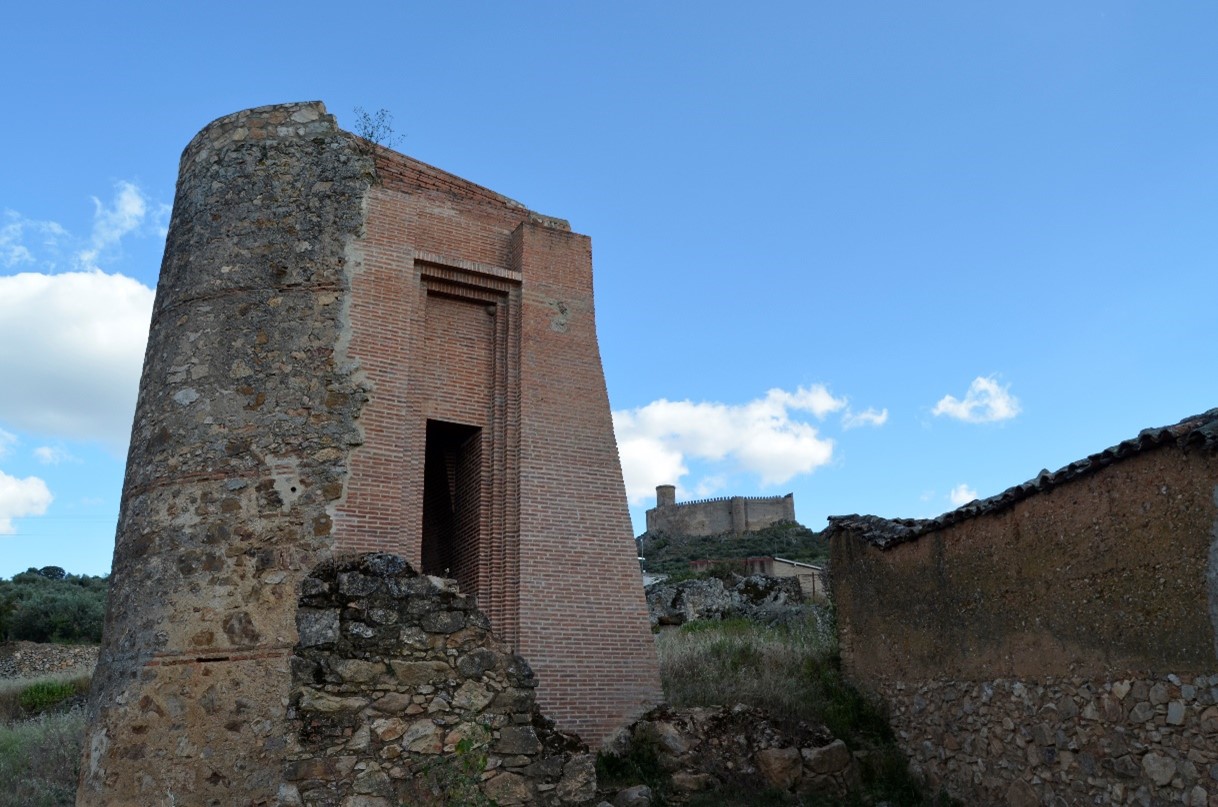
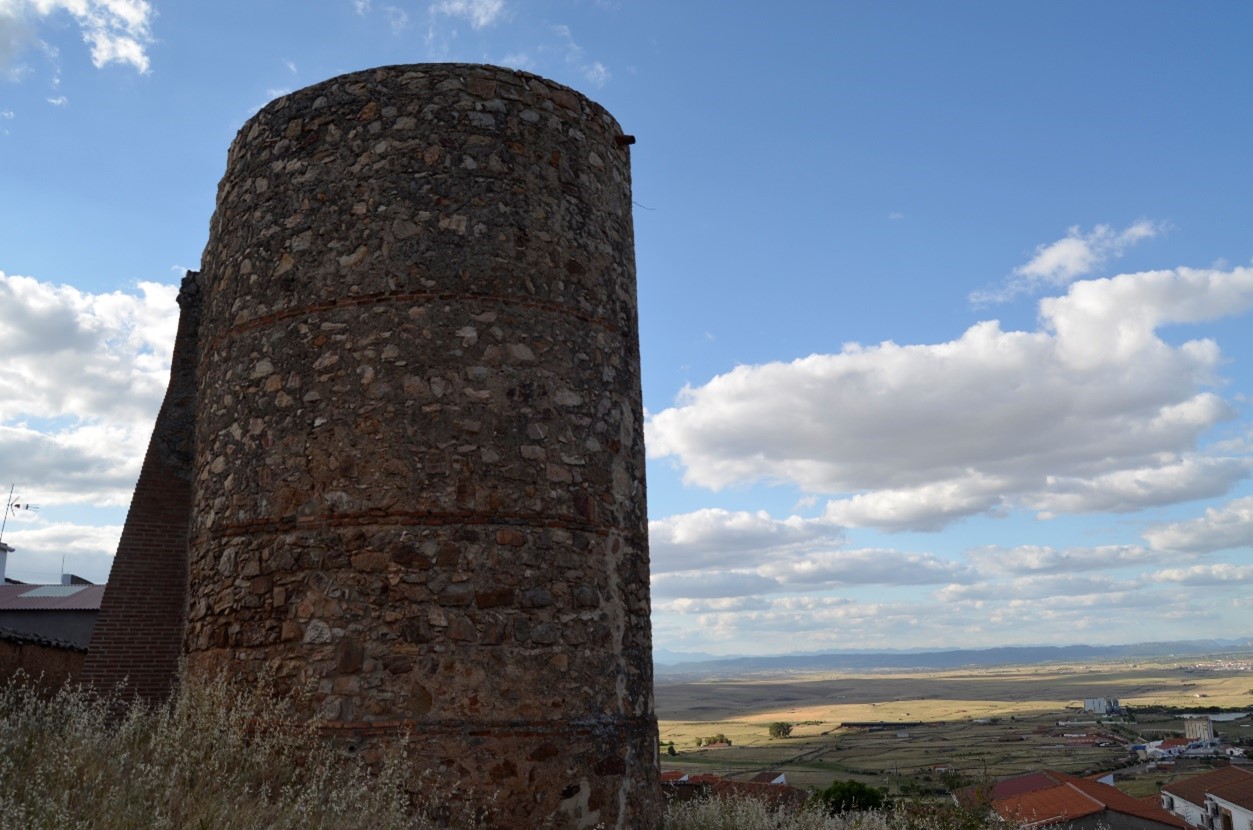
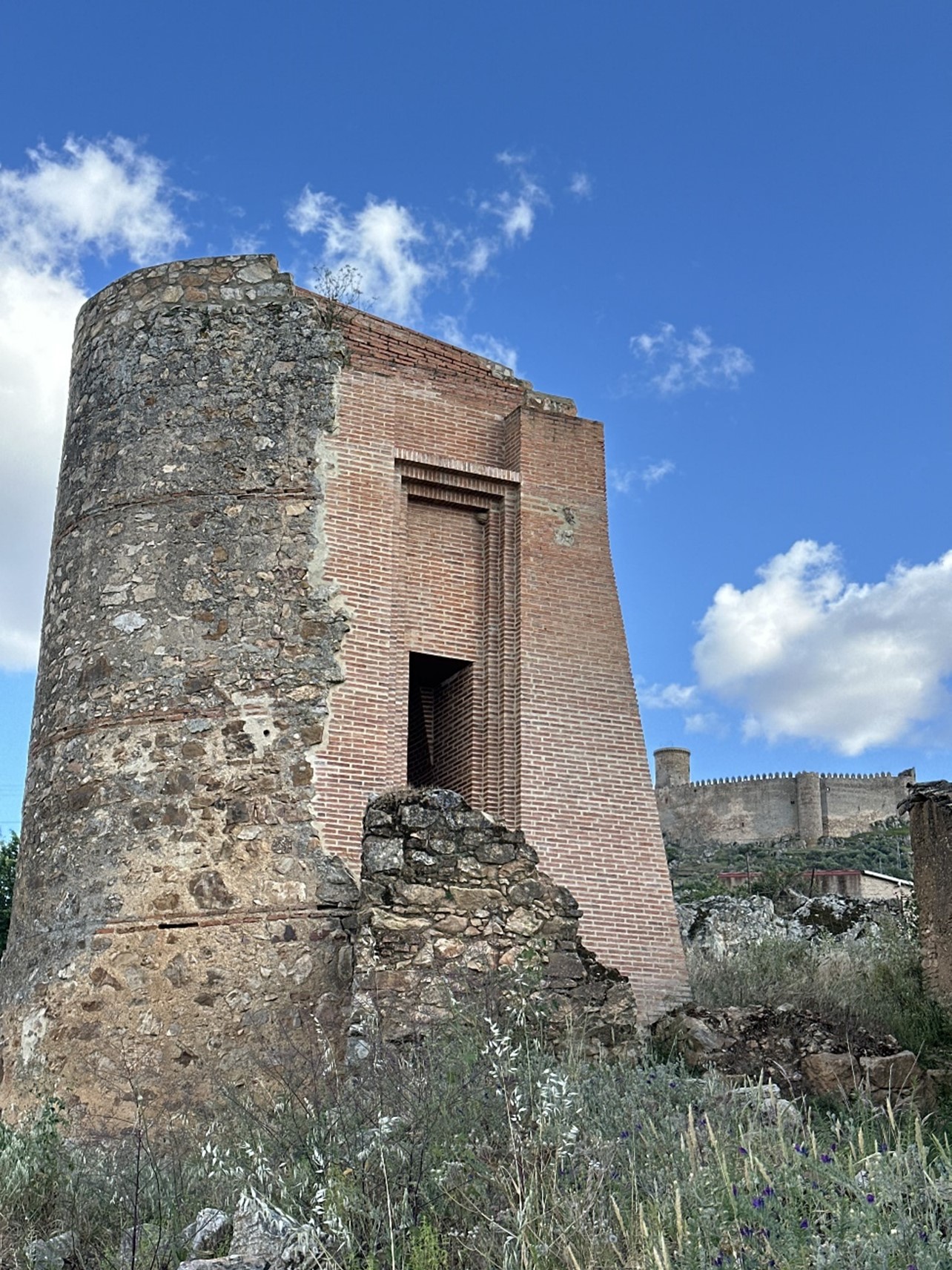
The Castillo Viejo, also called Torre del Postigo, is actually a walled enclosure from the Christian-medieval period, of which several scattered remains of masonry walls are preserved, together with a cylindrical tower combining masonry and brick courses, and the remains of another irregular masonry tower with a truncated conical shape.
When Muslims arrived in the Iberian Peninsula in the 8th century, Berber troops occupied the area and gave the settlement the name Miknasa, a designation related to the Berber group that invaded the territory. According to the Muslim chronicles of Ibn Hayyan, King Ordoño II of León crossed the Guadiana River in the year 915 to sack the city of Miknasa, and the Muslims built an initial defensive stronghold, from which the name Al-Qusayr derives, meaning fortress or alcázar in Arabic, later Castilianised after the Reconquest as “Alcocer”. It is most likely that Castillo Viejo is a site where several historical periods overlap: a possible settlement or fortress from the 3rd century BC, perhaps a later Roman occupation, and medieval defensive structures (Islamic and/or Christian) built over or beside those earlier ruins.
The popular name Castillo Viejo reflects the perception of local residents, who regard these ruins as a fortification older than the great castle of the Order of Alcántara that dominates Puebla de Alcocer. A rigorous archaeological excavation would allow each construction phase of this fortress to be precisely dated. Although Gutierre de Sotomayor was Master of the Order of Alcántara, the castle never belonged to the Order of Alcántara, as they were two different lordships.
Castillo Viejo represents the oldest phase of the defensive system of Puebla de Alcocer, predating the great fortress that currently dominates the hill. The existence of a fortified structure prior to the construction of the 15th-century castle confirms the continuity of the enclave’s strategic use since medieval times.
This original construction would have functioned as a watchtower or first defensive enclosure, later integrated into a more complex system when, in the 15th century, the main fortress was consolidated under the leadership of Gutierre de Sotomayor. The development of the main castle took advantage of earlier remains, reinforcing the interpretation of Castillo Viejo as the origin of the defensive complex.
HISTORICAL-ARTISTIC DESCRIPTION
Castillo Viejo corresponds to a typology of tower or defensive structure of austere character, built in masonry and adapted to the terrain conditions. Its configuration is simpler than that of the main castle, reflecting its initial function of surveillance and access control.
Its location, on the approach to the fortress, makes it possible to interpret the defensive system as a succession of phases in which territorial control was organised in a staggered manner. These types of structures were integrated into broader defensive complexes, evolving over time into more sophisticated fortifications such as the one built in the 15th century, with thick walls, inner courtyards and highly developed towers.
CONSERVATION AND RESTORATION INTERVENTIONS
At the beginning of the 2020s, consolidation and restoration works were carried out on one of the preserved towers of the so-called Castillo Viejo of Puebla de Alcocer. The intervention was directed by architect and monumental restoration specialist Santiago Esteban Hernán Martín, a native of Puebla de Alcocer and a recognised professional linked to heritage projects at national level. Santiago Esteban Hernán Martín has developed a broad professional career in the restoration, rehabilitation and conservation of historic buildings, and his work in monumental restoration has also received several European Europa Nostra recognitions.
At Castillo Viejo in Puebla de Alcocer, the works focused mainly on the consolidation and partial recovery of the preserved remains, especially the still-visible tower. The intervention sought to respect the building’s original construction essence through techniques compatible with the historic structure, integrating brick with stone according to criteria inspired by the traditional construction systems used during the medieval period. In addition to this intervention, Santiago Esteban Hernán Martín has promoted and carried out other heritage initiatives linked to the Viscounty of Puebla de Alcocer, including works at the Almohad Postigo, the Convento de la Visitación and various urban and heritage recovery projects within the locality.
RELEVANT FIGURES RELATED TO THE POI
Although it is not directly associated with documented individual figures, Castillo Viejo forms part of the historical process culminating in the construction of the main castle under Gutierre de Sotomayor, Master of the Order of Alcántara and key figure in the reorganisation of the territory during the 15th century.
INTANGIBLE HERITAGE
The memory of the medieval defensive system of Puebla de Alcocer and the evolution of the enclave from a primitive structure to the consolidation of a great fortress, a central element in the municipality’s historical identity.