DESCRIPTION
Parish church belonging to the Archbishopric of Toledo. Both in its design and construction, the temple preserves numerous architectural elements of interest.
HISTORY
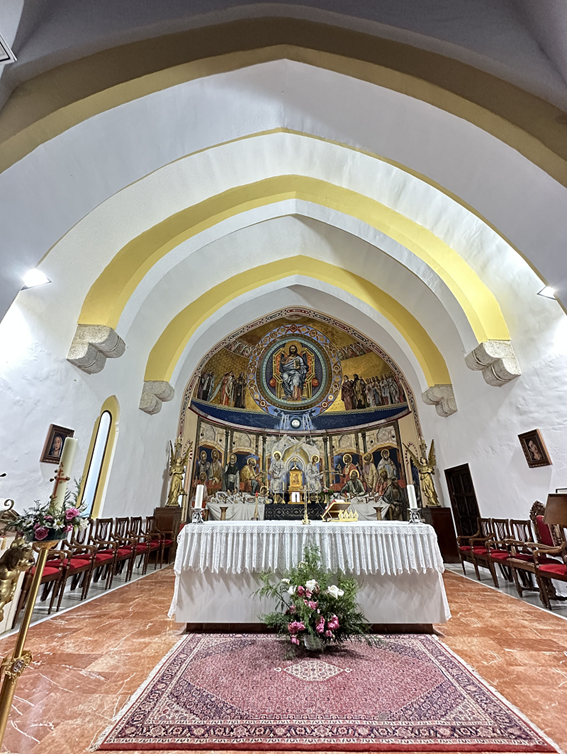
The Church of Santiago is a three-nave church with a circular apse, tower and elevated choir at the foot of the building. It is believed to have been built on the same site previously occupied by a Muslim mosque; in its current state, it appears to be a 14th-century Mudéjar structure belonging to the same stylistic group as contemporary churches within its area of influence, such as those of Herrera del Duque, Siruela, Talarrubias or Casas de Don Pedro.
The church probably acquired its present form through the initiative of Pedro I of Castile, King of Castile and León between 1350 and 1369, during the temporary lordship exercised by the Cabrera family over these lands, which would later become the origin of the Viscounty of Puebla de Alcocer, a title and territory claimed in the 15th century by Gutierre de Sotomayor, all-powerful Master of the Order and Habit of Alcántara.
HISTORICAL-ARTISTIC DESCRIPTION
The circular apse is built using mixed masonry of the so-called Toledo style, with masonry compartments framed between pilasters and brick courses, a construction system used throughout the building, now largely covered with lime render.
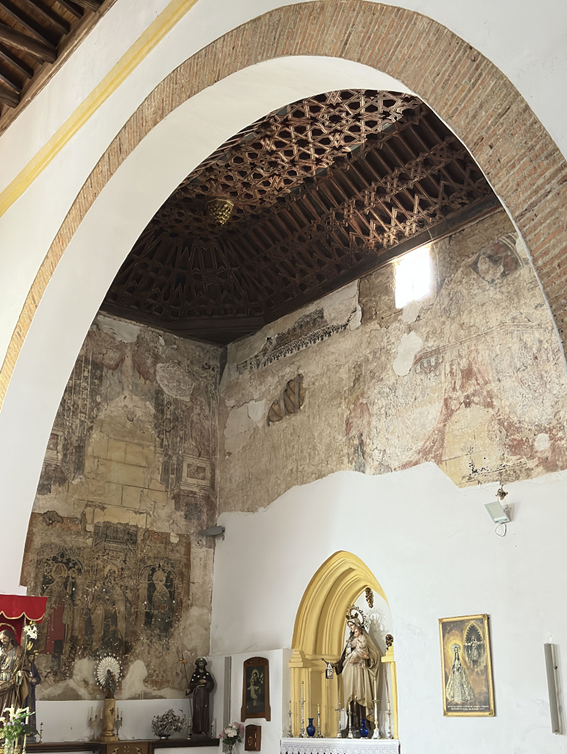
The wooden roof structures covering the naves, uncovered in the mid-20th century after the false plaster vaults that had concealed them since the Baroque period, are splendid examples of Mudéjar carpentry. The most important coffered ceiling — of paired rafters and collar beams with tie beams and eight-point star latticework — covers the epistle nave and still preserves its original polychromy.
The central nave, also of paired rafters and collar beams with tie beams, lacks latticework decoration, while the gospel nave, built without tie beams and with coffered panels, is later, perhaps Renaissance in style, probably dating from the 16th century.
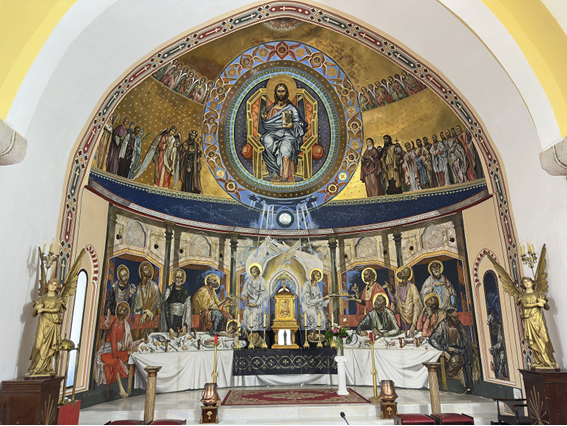
The main chapel lost its altarpieces: the Baroque one, of fine craftsmanship, with five sections and three tiers of painting and sculpture, was burned during the Spanish Civil War. The later altarpiece, recreated from its remains, has recently been replaced by frescoes that may be considered Neo-Romanesque, painted by the Russian artist Boris Lugovsky, who resides in Spain.
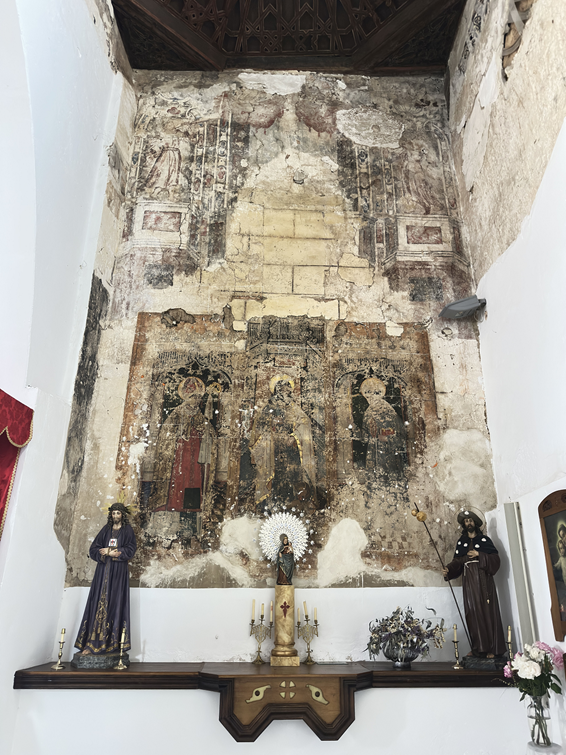
Painted on the head wall of the epistle nave around the year 1500, the altarpiece of Saint Bartholomew has been preserved, discovered behind a dismantled altarpiece and, together with the rest of the mural paintings preserved on the same wall, slightly later in date, it constitutes an extremely interesting example of Late Gothic painting in the region.
The doorway currently used as the main entrance, of Mudéjar style, is located at the foot of the church and leads into the central nave beneath the elevated choir. The former main entrance, also Mudéjar and oriented to the south, once overcame the considerable difference in height between the church floor and the square outside. It has since been sealed during modern renovations and now forms an elevated interior niche.
Opposite this doorway, to the north, a Renaissance portal was opened during the time of Gutierre de Sotomayor, upon which the turbulent life of this master appears to be summarised in the motto carved beside a globe: “TODO ES POCO” (“Everything is little”).
RELEVANT FIGURES RELATED TO THE POI
Pedro I of Castile, known as “the Cruel,” who died in 1369 at the Fields of Montiel during conflict with his brother Enrique — who would later reign as Henry II of Castile, founder of the Trastámara dynasty — was first buried in this church.
Until 1446, when he was transferred to Santo Domingo el Real in Madrid, his body remained in this church, having arrived from the castle of Montiel. His remains were moved again after the disentailment and demolition of the convent — on whose site the Plaza de Santo Domingo was later created — when they were transferred to the National Archaeological Museum before finally resting in the Cathedral of Seville, where they remain today.
The body of the Master of Alcántara, Fray Gutierre de Sotomayor, Lord of Gahete and Viscount of Puebla de Alcocer, also did not remain permanently in this church. He was buried here until 1481, when his remains were transferred to Belalcázar — the new name given to the town of Gahete after the construction of the castle — capital of his lordship, where they are still preserved in the Convent of Santa Clara de la Columna.
This transfer was carried out with the intention of creating a prestigious family pantheon in this convent founded by his lineage. The project, involving reforms to the existing structure, was designed by Hernán Ruiz the Younger in 1540, although it was never completed. Alongside the remains of his father travelled those of his son Alfonso de Sotomayor, II Lord of Gahete, who died in a duel, probably in Deleitosa, in 1464.
Fray Fernando de Moraga also remains buried in this church. He was a missionary in Mexico and the Philippines who died in a shipwreck off the coast of Portugal while returning to his hometown. His body was brought to this church to await Judgment Day. His funerary slab, located at the foot of the central nave before the doorway, appears to have been moved from its original position.
Also related to this church is Fray Juan de la Puebla (1453–1495), known in secular life before becoming first a Hieronymite and later a Franciscan monk as Gutiérrez de Sotomayor, II Lord of Gahete, advisor to kings and popes and founder in Extremadura of the Custody of the Angels. Having died in the odour of sanctity, his remains eventually ended up in Belalcázar after passing through several locations where relics of him are still preserved.
MOVABLE HERITAGE
Gothic silver ciborium.
INTANGIBLE HERITAGE
The Brotherhood of Santiago.
Military necessities led Spanish monarchs to promote the creation of reserve cavalry forces, the best known of which were the Maestranzas. However, certain brotherhoods were also founded for this purpose, such as the Brotherhoods of Santiago and Nuestra Señora de Gamonal in Burgos, and the Brotherhood of Santiago in Puebla de Alcocer, traditionally believed to have been founded during the reign of Fernando III the Saint (1217–1252).
This cavalry force, formed by mounted civilians prepared to act as support for the king’s armies, regularly held equestrian skill games for training purposes, such as the throwing of the bohordo. A reminiscence of these demonstrations of skill survives today in the “alardes” still celebrated in many towns across the Iberian Peninsula.