IDENTIFICATION AND LOCATION
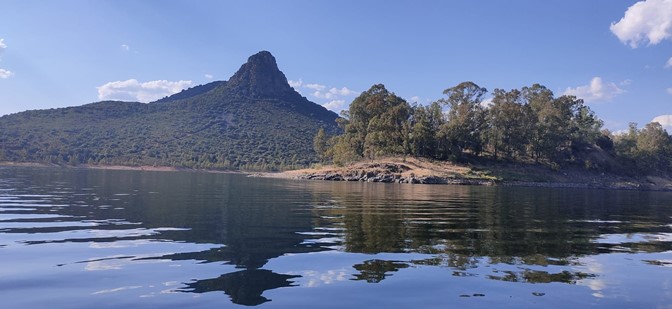
The archaeological complex of the Dolmen of Valdecaballeros and the Hillfort of Cerro de la Barca is located in an area of great scenic value southeast of the municipality of Valdecaballeros, in the region of La Siberia in Extremadura. The site lies near the confluence of the Guadiana and Guadalupejo rivers, currently partially surrounded by the waters of the García de Sola reservoir, which reinforces its character as an “island” or isolated hill.
The site combines prehistoric megalithic remains and pre-Roman defensive structures, forming one of the most significant archaeological complexes in the northeast of the province of Badajoz.
HISTORY
Human occupation of Cerro de la Barca dates back at least to the 4th–2nd millennium BC, when the megalithic funerary monument of the tholos type known as the Dolmen of Valdecaballeros or tholos of Cerro de la Barca was built. This large collective tomb belongs to the Chalcolithic period, when the region’s farming and livestock communities erected large stone tombs for their dead, linked to complex beliefs about death and the afterlife.
Subsequently, the site was occupied again during the Iron Age, between the 8th and 3rd centuries BC, when a fortified hillfort was developed, taking advantage of the strategic position of the hill as a control point between the Meseta and the Guadiana basin. The continuity of occupation throughout different historical periods makes this site an important testimony to the evolution of settlement in the La Siberia region.
Human occupation of Cerro de la Barca dates back at least to the 4th–2nd millennium BC, when the megalithic funerary monument of the tholos type, known as the Dolmen de Valdecaballeros or tholos of Cerro de la Barca, was constructed. Subsequently, the site was occupied again during the Iron Age, between the 8th and 3rd centuries BC, when a fortified hillfort was developed, taking advantage of the strategic position of the hill as a control point between the Meseta and the Guadiana basin. The continuity of occupation throughout different historical periods makes this site an important testimony to the evolution of settlement in the La Siberia region.
THE DOLMEN OF VALDECABALLEROS
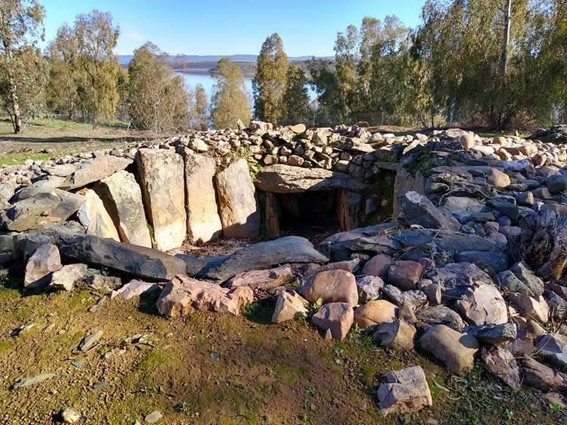
The Dolmen of Valdecaballeros, also known as the tholos of Cerro de la Barca, is one of the most outstanding examples of prehistoric funerary architecture in Extremadura.
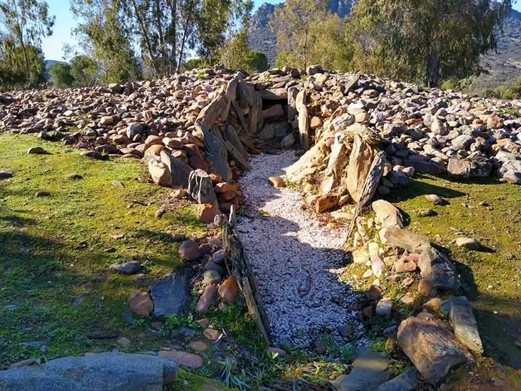
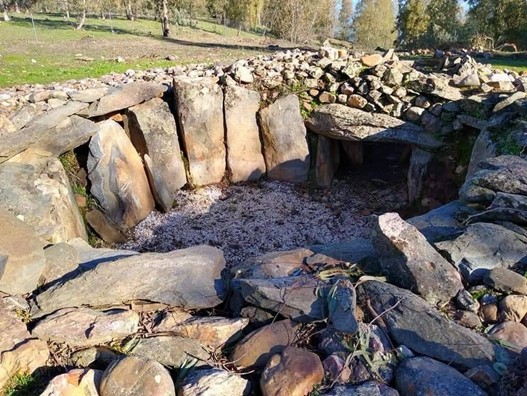
It is a megalithic monument built during the Chalcolithic period using large stone blocks arranged to form a circular chamber and a long corridor oriented toward the sunrise. Archaeological studies document the existence of a false dome originally covered by a large mound of earth and stones.
The chamber presents characteristics similar to other major megalithic monuments in Extremadura, such as the dolmens of Lácara or Tremedal. It preserves orthostats decorated with linear engravings, small cup marks, and traces of pigment that are difficult to identify.
The complex was looted at an undetermined moment in its history, although it still preserves part of the side stones of the corridor and the main chamber. The trilithic portal remains relatively complete, while the original covering disappeared over time.
Inside, human remains and ceramic fragments associated with collective funerary rituals were discovered, confirming its use as a ceremonial and burial site during Recent Prehistory.
When the light of dawn passes through the corridor and enters the chamber, the monument acquires a symbolic dimension that has led to the interpretation of the dolmen not only as a tomb, but also as a space linked to ritual conceptions related to the sky, death, and natural cycles.
THE HILLFORT OF CERRO DE LA BARCA
Next to the dolmen lies the so-called Castro del Cerro de la Barca, popularly known as “La Isla”, an Iron Age fortified settlement located on a conical hill between the municipalities of Valdecaballeros, Castilblanco, and Herrera del Duque. The hillfort took advantage of the natural conditions of the terrain to strengthen its defenses, visually dominating the territory and the natural passages near the Guadiana River. Although much of its structures remain partially hidden or altered by the action of the reservoir waters, remains of walls and construction elements associated with the defensive system are still visible.
The site presents evidence of residential structures and archaeological materials that allow it to be interpreted as a true fortified citadel of a strategic and defensive nature.
To date, much of the site remains pending excavation and systematic research.
HISTORICAL-ARTISTIC DESCRIPTION
The archaeological complex stands out for the coexistence in the same space of two major heritage manifestations from very different periods: the Chalcolithic megalithic funerary architecture and the pre-Roman fortifications of the Iron Age.
The dolmen represents one of the best regional examples of a funerary tholos, characterized by its circular chamber, monumental corridor, and the use of large stone orthostats.
For its part, the hillfort corresponds to the typology of a fortified settlement adapted to the natural terrain conditions, using the elevation of the hill and visual control of the surroundings as fundamental defensive elements.
The site also offers extraordinary scenic value, currently enhanced by the presence of the waters of the García de Sola reservoir, which partially surround the hill and enhance its visual uniqueness within the landscape of La Siberia.
ARCHAEOLOGICAL AND MOVABLE HERITAGE
Ceramic materials, construction remains, and elements associated with both the funerary use of the dolmen and the defensive occupation of the hillfort have been documented at the site. The engravings and cup marks present on some of the orthostats constitute one of the most singular aspects of the megalithic monument, although their exact meaning continues to be the subject of study. Much of the archaeological potential of the complex still remains pending detailed scientific investigation.
LANDSCAPE AND NATURAL ENVIRONMENT
Cerro de la Barca is integrated into a landscape characteristic of the La Siberia Biosphere Reserve, marked by gentle reliefs, dehesas, bodies of water, and Mediterranean forest areas.
The dominant position of the hill above the confluence of the Guadiana and Guadalupejo rivers makes the site an exceptional natural viewpoint over the surrounding territory.
The combination of archaeological heritage, terrain, and water creates one of the most unique historical and scenic enclaves in the region.
INTANGIBLE HERITAGE
The Dolmen and the Hillfort of Cerro de la Barca form part of the historical imagination of Valdecaballeros as testimony to the oldest origins of human settlement in the area.
The monumentality of the dolmen, the strategic position of the hillfort, and the isolated landscape of the hill have contributed to generating a perception of a place full of symbolism and mystery, where landscape, memory, and archaeology remain closely linked.
MOVABLE HERITAGE
Although the site has been subjected to looting both in antiquity and in recent times, various elements have been recovered that make it possible to partially reconstruct its use. Among them are necklace beads, flint arrowheads, fragments of decorated pottery, and engraved plaques, some of them made from non-local materials, indicating contacts with other human groups.
INTANGIBLE HERITAGE
The Tholos of Cerro de la Barca represents one of the oldest milestones of human occupation in the La Siberia region. Its presence reinforces the connection between the territory and its prehistoric roots, becoming a symbol of the area’s remote past.
The uniqueness of its location, emerging or disappearing depending on the water level of the reservoir, adds an almost mythical dimension to the place, which remains linked to the collective memory as a space where time, landscape, and history converge in a unique way.