DESCRIPTION
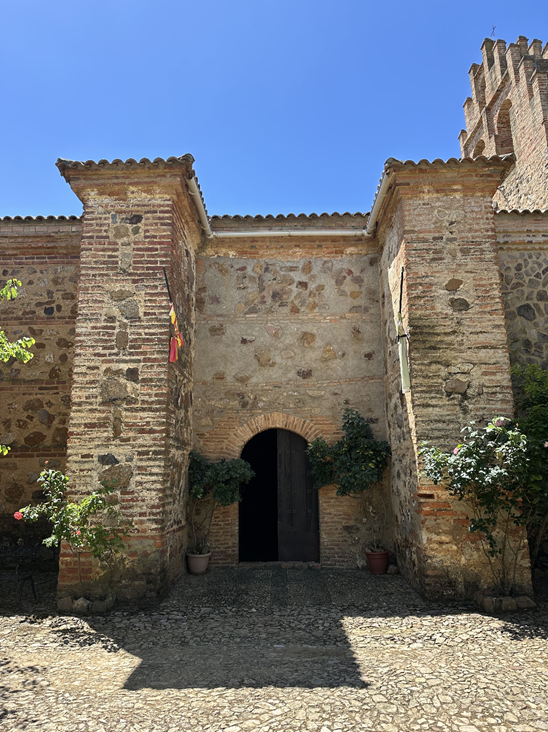
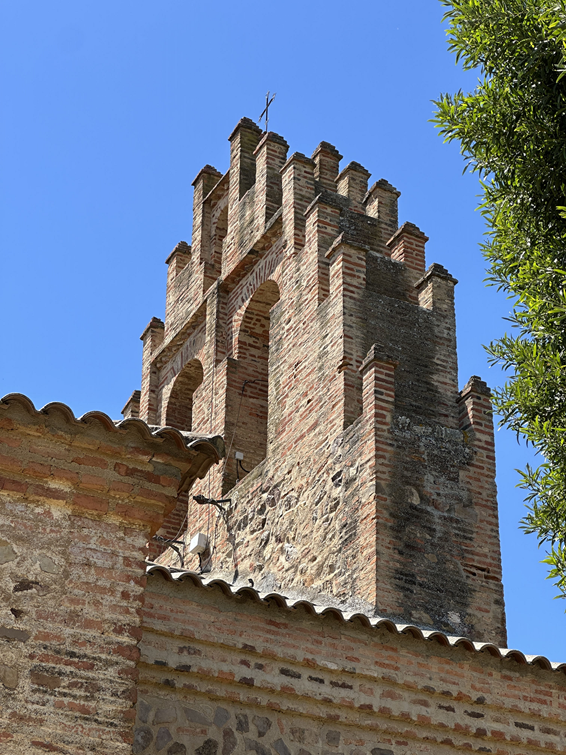
The hermitage of Nuestra Señora de Nazaret is located in the surroundings of the urban centre of Garlitos, constituting one of the municipality’s principal heritage landmarks. It is a building of notable architectural presence, characterised by its compact volume and stepped bell gable, whose silhouette blends into the landscape and recalls traditional construction models of the comarca.
HISTORY
The hermitage probably has a medieval origin, with its construction dating to around the 13th century, within a context linked to the reorganisation of the territory following the Reconquista. The site on which it stands has a long continuity of occupation, since, according to various references, a temple dedicated to Cybele and later a Visigothic basilica previously existed in this same location.
Added to this historical sequence is the presence of Roman remains, visible in the form of stone inscriptions embedded in the walls of the building, referring to the ancient city of Miróbriga, which reinforces the historical and symbolic character of the site as a space of continuous occupation.
Over time, the building has undergone various transformations and additions that have shaped its current appearance. Among the documented interventions, the restoration of the bell gable and part of its façades in 1996 stands out.
HISTORICAL AND ARTISTIC DESCRIPTION
From an architectural point of view, the hermitage presents a solid construction in which its thick walls and stepped bell gable stand out, an element that defines its exterior profile.
Several reused Roman inscriptions are preserved in its walls, integrated into the structure of the building, providing added value to the ensemble by evidencing the reuse of materials from earlier settlements.
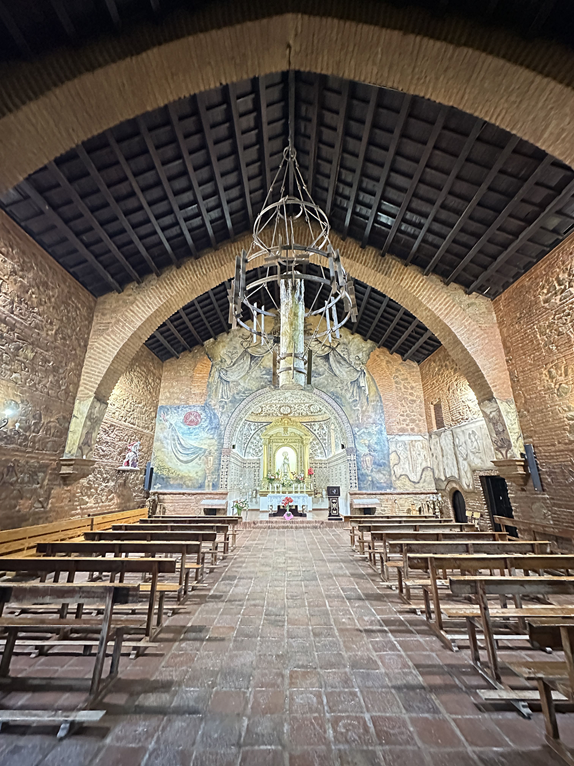
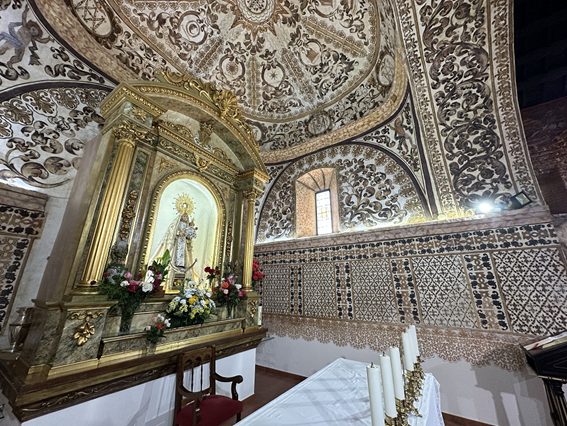
Inside, mural paintings that have undergone restoration are preserved, as well as a notable floor dating from 1878, which forms part of the renovations carried out during later periods.
The ensemble corresponds to a model of rural religious architecture, adapted to the liturgical needs and construction resources available at each historical period.
RELEVANT FIGURES RELATED TO THE POI
No specific figures directly linked to the construction of the hermitage are documented, although its origin is related to the historical processes of occupation and organisation of the territory during the medieval period.
MOVABLE HERITAGE
Inside the temple, elements such as the restored mural paintings and the 19th-century tiled flooring stand out. Likewise, the reused Roman inscriptions embedded in the building’s walls constitute elements of great historical value integrated into the architectural ensemble itself.
INTANGIBLE HERITAGE
The hermitage is linked to the religious and devotional tradition of the locality, constituting a reference space for the community and a point of continuity between different historical stages of the territory.
Its location on a site of prolonged occupation over time reinforces its symbolic value as a place of worship and collective memory.