DESCRIPTION
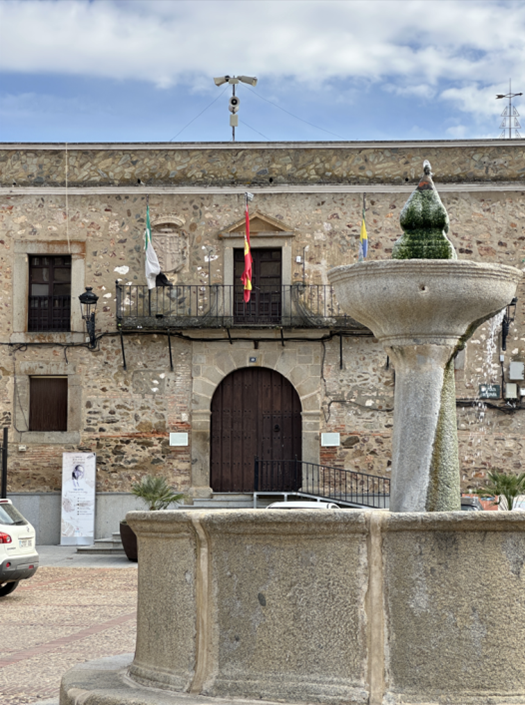
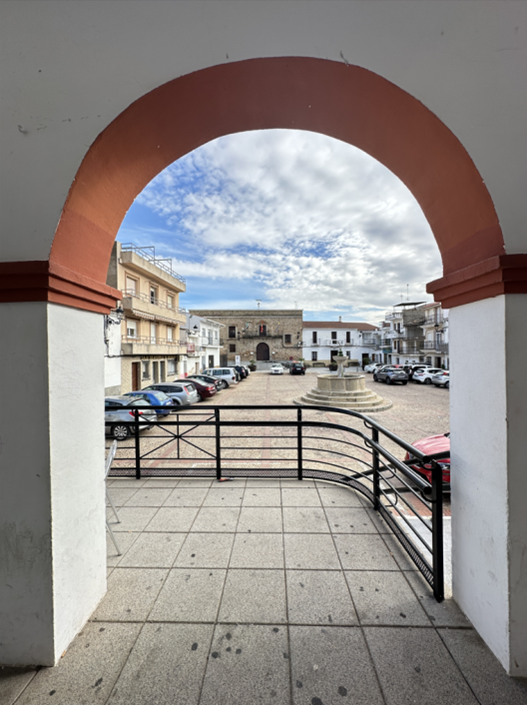
Urban ensemble formed by the Town Hall building and the Fuente de la Plaza de España, located in the central area of Esparragosa de Lares. The Town Hall constitutes one of the town’s most representative civil buildings and stands out for the presence inside of bull pens used during the bullfighting celebrations of the patron saint festivities. Opposite the building is the Fuente de la Plaza de España, a 19th-century granite construction historically linked to the municipality’s water supply.
HISTORY
The Town Hall building, formerly the Palace of the Encomienda of Esparragosa de Lares, was built from 1589 onwards following the designs of Juan Bravo, according to Víctor Guerrero Cabanillas, official chronicler of the municipality.
Among the commanders of Lares who occupied this building or its predecessors were leading historical figures such as Nicolás de Ovando, who was appointed commander of Lares in 1478 and, between 1501 and 1509, held the governorship of the Indies by appointment of Isabella the Catholic.
A building with more than four centuries of history, which went from being the centre of power of one of the most important encomiendas of the Order of Alcántara to becoming the municipality’s town hall.
HISTORICAL AND ARTISTIC DESCRIPTION
The town hall building follows a traditional architecture built in masonry and stone, linked to the town’s administrative and festive functions. Inside, it preserves nine bull pens intended for holding bulls and heifers used during the patron saint festivities, an element that demonstrates the importance of the bullfighting tradition in Esparragosa de Lares. The Fuente de la Plaza de España was built in the 19th century and historically served as a water supply source in the population’s main gathering space.
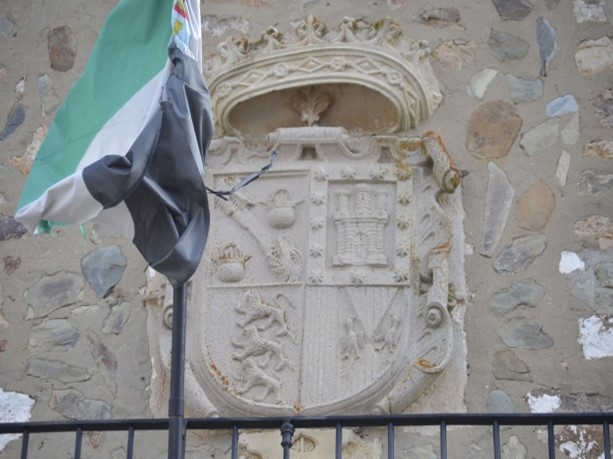
It is built in masonry and stone and features a heraldic granite coat of arms on its façade. The main doorway is defined by a semicircular stone arch, above which opens a window topped with a triangular pediment. A wide balcony supported by an iron ledge extends across much of the main façade.
The building also features different openings with stone lintels distributed irregularly, as well as moulded parapets that contribute to enlivening the architectural composition.
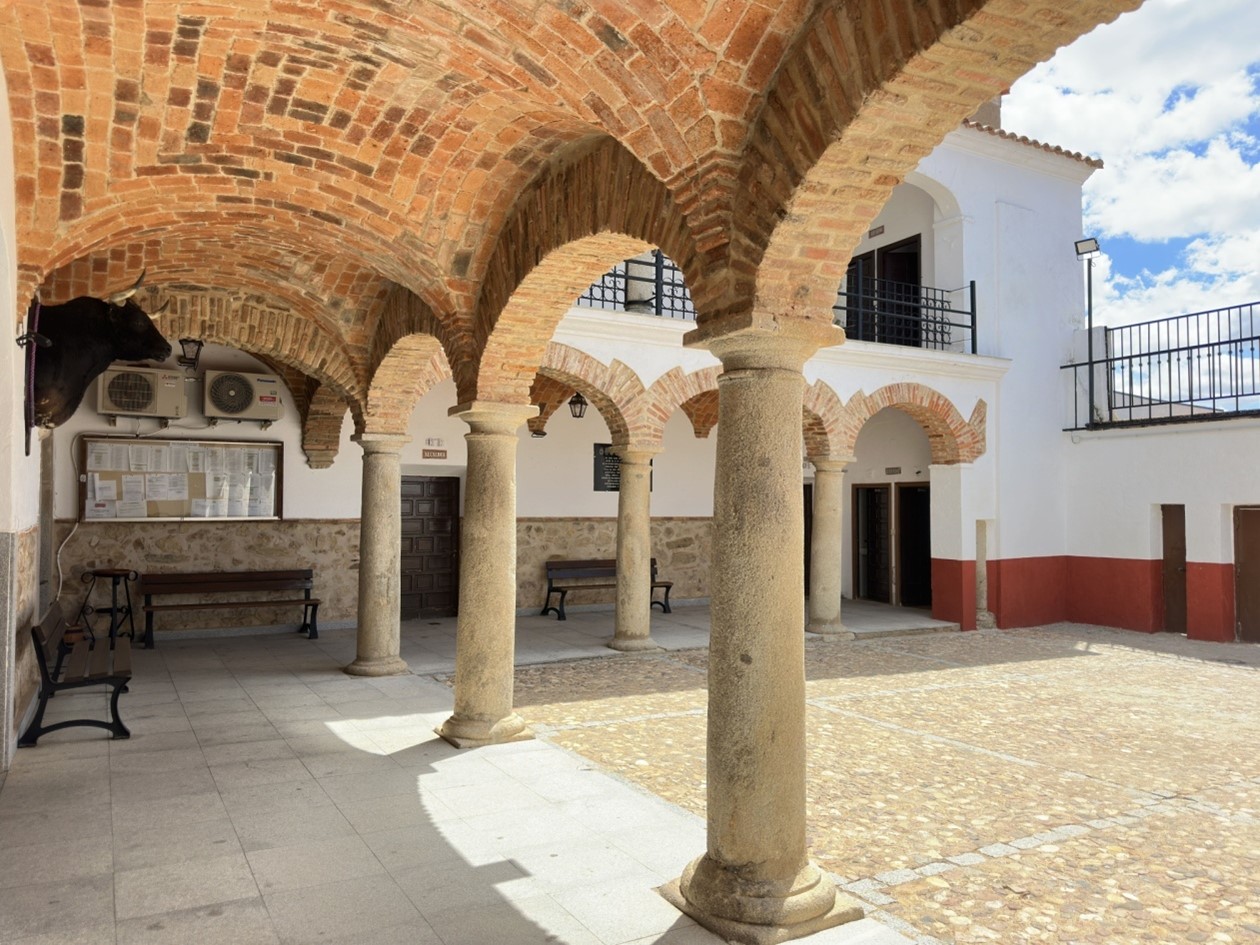
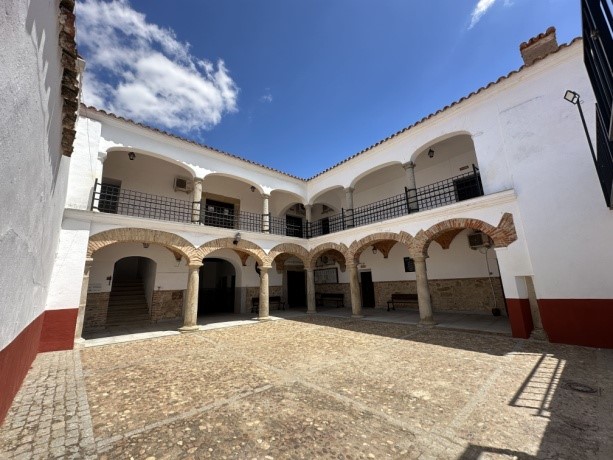
Inside, there is a two-storey courtyard with arcades on two of its sides, supported by cylindrical granite columns. The arches are lowered on the lower floor and segmental on the upper floor. Access to the second floor is provided by a staircase with granite steps and a wrought-iron railing.
One of the building’s most singular elements is the nine bull pens located inside, used to confine the bulls and heifers fought during the municipality’s patron saint festivities.
The Fuente de la Plaza de España, built in granite, is located in the centre of the square. It consists of a circular basin with steps around it and a central cylindrical shaft topped with a cup-shaped structure. Water flows from a four-sided pyramidal pivot and pours into the basin through openings in the upper cup.
RELEVANT FIGURES RELATED TO THE POI
The ensemble is linked to the institutional and festive life of Esparragosa de Lares, especially to the traditional bullfighting celebrations held during the municipality’s patron saint festivities.
MOVABLE HERITAGE
Heraldic granite coat of arms of the Town Hall, interior and exterior wrought-iron elements, railings, traditional carpentry and structures linked to the bull pens used during the bullfighting celebrations.
INTANGIBLE HERITAGE
The building maintains a close relationship with the patron saint festivities and bullfighting celebrations of Esparragosa de Lares. The bull pens preserved inside the Town Hall constitute a singular element linked to the traditional organisation of bull runs and popular festivities in the town.