DESCRIPTION
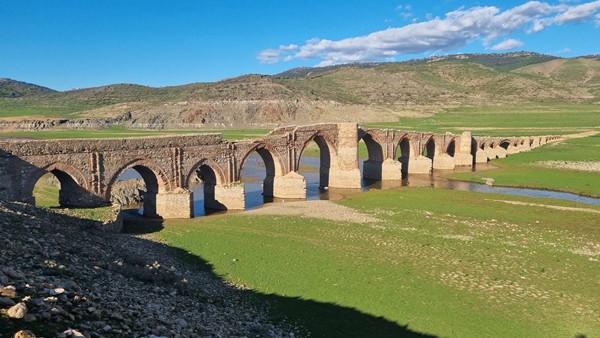
Hidden for much of the year beneath the waters of the Cijara reservoir, the Puente de la Mesta constitutes one of the most singular and monumental medieval constructions in the whole of La Siberia extremeña. Located over the Guadiana River, within the municipal boundaries of Villarta de los Montes, this extraordinary Mudéjar bridge was for centuries a fundamental infrastructure for peninsular transhumance and livestock transit linked to the powerful institution of the Honrado Concejo de la Mesta.
When the water level of the reservoir drops, its pointed arches, cutwaters and long stretches of stone paving partially emerge, offering an image of enormous historical and landscape significance. Over time, its semi-submerged silhouette has become one of the most recognisable heritage symbols of the Cijara surroundings.
The construction measures approximately 225 metres in length and preserves 16 main arches, although various studies raise the total number of spans to 27, including secondary arches and auxiliary structures. Its construction combines masonry and brick following Mudéjar models with Gothic influences.
The severe deterioration suffered since the construction of the Cijara reservoir in 1956 led to its inclusion in May 2022 on the Hispania Nostra Red List of Heritage, where it appears as a monument at risk of disappearance or serious alteration of its historical and architectural values.
HISTORY
The Puente de la Mesta originated in connection with one of the most important economic activities of the Crown of Castile: transhumance.
The bridge takes its name from the Honrado Concejo de la Mesta, an institution created in 1273 by King Alfonso X the Wise to protect the interests of Castilian and Leonese livestock breeders and shepherds, especially those related to wool production and trade.
The bridge formed part of the route of the Cañada Real Segoviana, one of the great historic livestock routes of the Iberian Peninsula. Thousands of head of livestock from Castilla y León crossed this passage heading towards the winter pastures of Extremadura, returning north with the arrival of summer.
Various sources place the original construction of the bridge at the end of the 14th century, although its strategic and economic importance led to continuous repairs and later interventions.
In 1563 the bridge was already in a serious state of deterioration and the passage of livestock had become dangerous. There are references to requests made by the inhabitants of Villarta for its repair, although these were initially not carried out.
Finally, in 1573, the Consejo de la Mesta officially promoted its restoration through the corregidor of Toledo, obtaining royal authorisation and funding to undertake the works. These were awarded on 30 March 1574 to the Toledo master mason and stonemason Jerónimo de Espinosa for the sum of 4,500 ducats, as recorded in the corresponding royal decree.
The bridge continued to be used for centuries as an essential infrastructure for transhumance until the gradual decline of these traditional livestock routes.
The major turning point in its history came with the construction of the Cijara reservoir in the 1950s. Since 1956, much of the bridge has remained submerged for long periods beneath the waters of the Guadiana, a circumstance that has significantly accelerated its structural deterioration.
HISTORICAL AND ARTISTIC DESCRIPTION
The Puente de la Mesta constitutes one of the most important examples of Mudéjar civil architecture linked to livestock routes in Extremadura.
The construction consists of 27 arches, extends over more than 225 metres and presents a complex succession of arches of different dimensions and typologies. Most are pointed, although there are formal differences between various sectors of the bridge, resulting from historical enlargements, repairs and reconstructions.
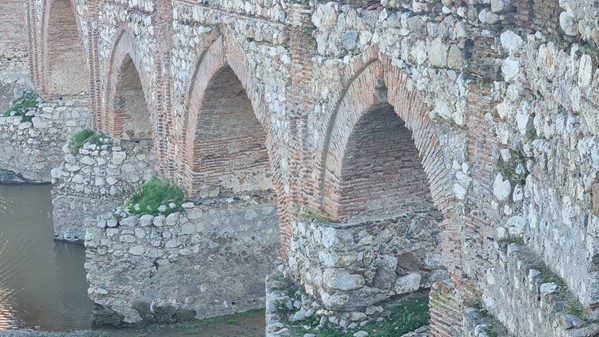
The five southernmost arches maintain a notable stylistic relationship with another four northern arches, all executed with pointed brick structures framed within alfiz mouldings, creating an interesting symbiosis between Gothic and Mudéjar solutions.
The bridge combines masonry and brick, materials highly characteristic of peninsular Mudéjar architecture. Also noteworthy are the large cutwaters and cylindrical buttresses designed to reduce the pressure of the Guadiana waters.
Various sources refer to 16 main arches, while other studies raise the total number to 27 spans including secondary structures and auxiliary passages. The ensemble also reveals different construction phases and historical repairs, especially those promoted during the 16th century by the Consejo de la Mesta.
THE BRIDGE AND TRANSHUMANCE
The historical importance of the bridge cannot be understood without transhumance and the network of peninsular livestock routes. The Puente de la Mesta was considered a true gateway to the winter pastures of Extremadura. Thousands of merino sheep crossed this point every year following the Cañada Real Segoviana, one of Spain’s principal historic livestock routes.
The Duque de Osuna owned one third of the bridge, while the Toledo cathedral chapter held ownership of the remaining two parts. This property generated substantial revenues and was also probably the source of various conflicts until the abolition of tolls or passage taxes by the Law of 31 December 1881.
The town of Villarta de los Montes itself preserves other elements linked to the world of the Mesta and transhumance, demonstrating the enormous importance this territory had as an area of passage and livestock use.
The nearby Ermita de Nuestra Señora de la Antigua is located precisely on an old Mesta resting area, further reinforcing the historical relationship between the municipality and the great livestock routes.
STATE OF CONSERVATION
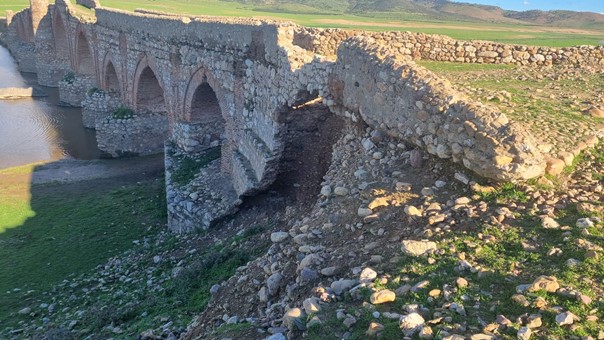
The current condition of the Puente de la Mesta is highly concerning. The continuous alternation between submersion and exposure caused by the waters of the Cijara reservoir has significantly accelerated the deterioration of the structure. Various reports especially warn about the poor condition of the main vault springing, the historic railings and large sectors of the original paving.
Erosion caused by water, abandonment and the lack of comprehensive interventions have generated major structural damage that seriously threatens the conservation of the monument. For all these reasons, in May 2022 the bridge was included on the Heritage Red List prepared by Hispania Nostra, an organisation dedicated to the defence and conservation of Spanish cultural heritage at risk.
Currently, the bridge is only visible when the reservoir level drops considerably, a circumstance that turns each reappearance of the monument into a landscape and heritage event of enormous visual impact.
HERITAGE VALUE
The Puente de la Mesta constitutes one of the most important testimonies of architecture linked to transhumance in Extremadura and one of the great historical vestiges of the peninsular Mesta network.
Its monumentality, antiquity, relationship with the Cañada Real Segoviana and singular semi-submerged situation beneath the waters of the reservoir make this site an exceptional heritage element within the comarca of La Siberia.
In addition to its enormous architectural and historical interest, the bridge possesses strong symbolic value as a memory of the pastoral and transhumant culture that for centuries shaped the landscape and economy of the peninsular interior.