DESCRIPTION
Historic monument located at the entrance to Fuenlabrada de los Montes, known as the Rollo de Santa Ana, which constitutes a symbol of the town’s jurisdiction and autonomy since medieval times.
HISTORY
The Rollo de Santa Ana originated in the Middle Ages, in a context in which towns that obtained their own jurisdiction erected this type of monument as a visible symbol of their ability to administer justice.
Known as the “Pingote de Santa Ana”, it is a medieval monument erected in 1212, located at the entrance to the village. Its purpose was to make all visitors aware that they were entering a town with its own rights and justice system. This makes it one of the oldest monuments in the La Siberia region of Extremadura.
These elements, known as rollos or picotas, marked the legal status of the municipality, indicating that it had the authority to exercise judicial functions without depending on other higher jurisdictions.
Its location at the entrance to the urban centre was not accidental, as it fulfilled a representative and deterrent function, showing those entering the town that they were in a territory with its own rules and the ability to enforce them.
Over time, the monument has undergone conservation interventions, especially those carried out in 1973, when the ground on which it stands was adapted, levelling the base and incorporating steps that reinforce its stability and presence.
HISTORICAL AND ARTISTIC DESCRIPTION
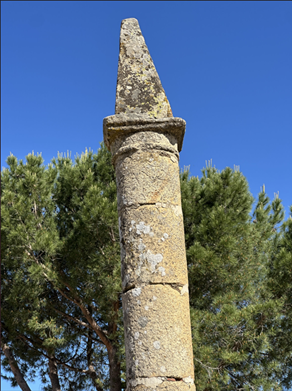
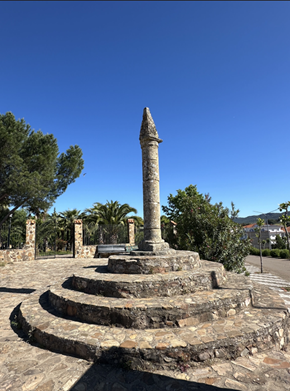
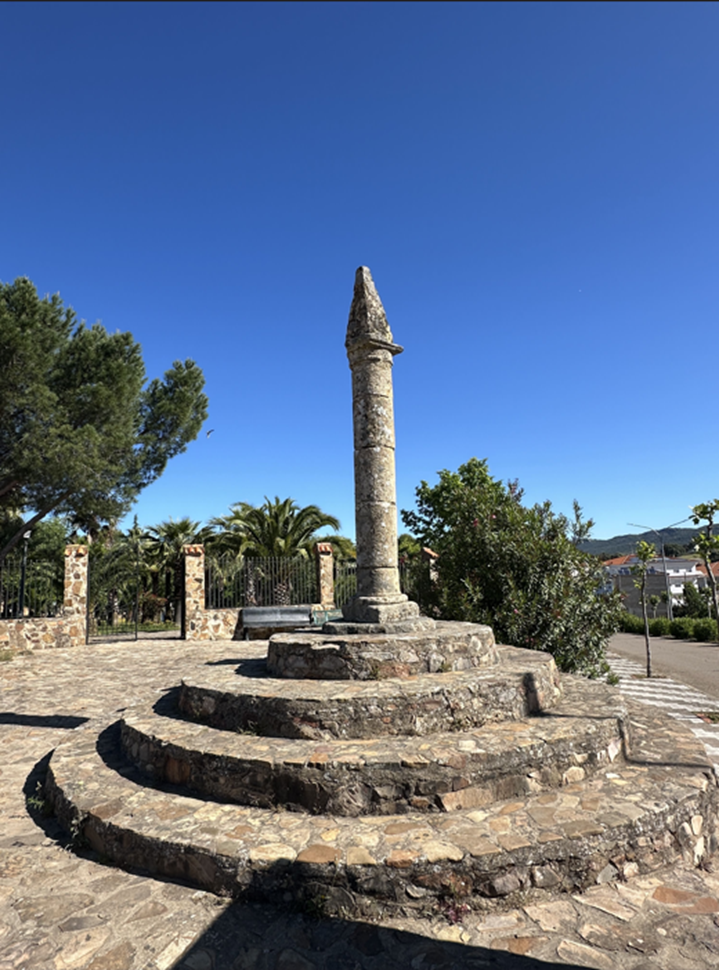
The rollo is made of granite and features a vertical structure composed of several superimposed drums, forming a robust and simple-looking column.
It rises on a stepped base that enhances its visibility and gives it greater monumentality within the surroundings. This type of base, in addition to fulfilling a structural function, reinforces the symbolic character of the element.
The ensemble is topped with a pyramidal-shaped piece that crowns the column and completes the monument’s vertical composition. Its formal sobriety responds to the functionality of the element, more linked to its meaning than to ornamentation.
Its isolated arrangement and strategic location allow a clear interpretation of the monument as a territorial landmark, integrating into the urban landscape as one of the first elements to welcome visitors.
RELEVANT FIGURES RELATED TO THE POI
The rollo is not linked to a specific individual, but rather to the collective authority of the town and the institutions that administered justice in the name of seigneurial or royal power.
Its existence reflects medieval legal organisation and the community’s capacity for self-government, constituting a symbol of local power and the territory’s administrative structure.
MOVABLE HERITAGE
Monumental granite stone element composed of column, base and upper finial.
INTANGIBLE HERITAGE
The Rollo de Santa Ana forms part of the historical memory of Fuenlabrada de los Montes as a symbol of its status as a town with its own jurisdiction, representing values associated with justice, order and collective identity.